
 Buy Crypto
- Markets
 Futures
- Spot
- Copy Trade
- Earn
- More
Warmonger Trump has forgotten about Americans waiting in airport lines for hours

In recent times, international news has been dominated by the Iran situation and President Trump's fluctuating stance on the war.
However, one thing that once monopolized the headlines in 2025 is now rarely mentioned in the mainstream media—on February 14, due to a deadlock between the Democrats and Republicans on the Department of Homeland Security (DHS) funding bill, a partial DHS shutdown officially began.
As of today, the shutdown has not ended.
During this nearly two-month shutdown period, over 100,000 DHS employees have been unable to receive their pay, and nearly 11% of Transportation Security Administration (TSA) employees have been absent. In New Orleans, passengers queuing for security screening snaked from inside the terminal building to outside, even circling the parking lot seven times before reaching the entrance.
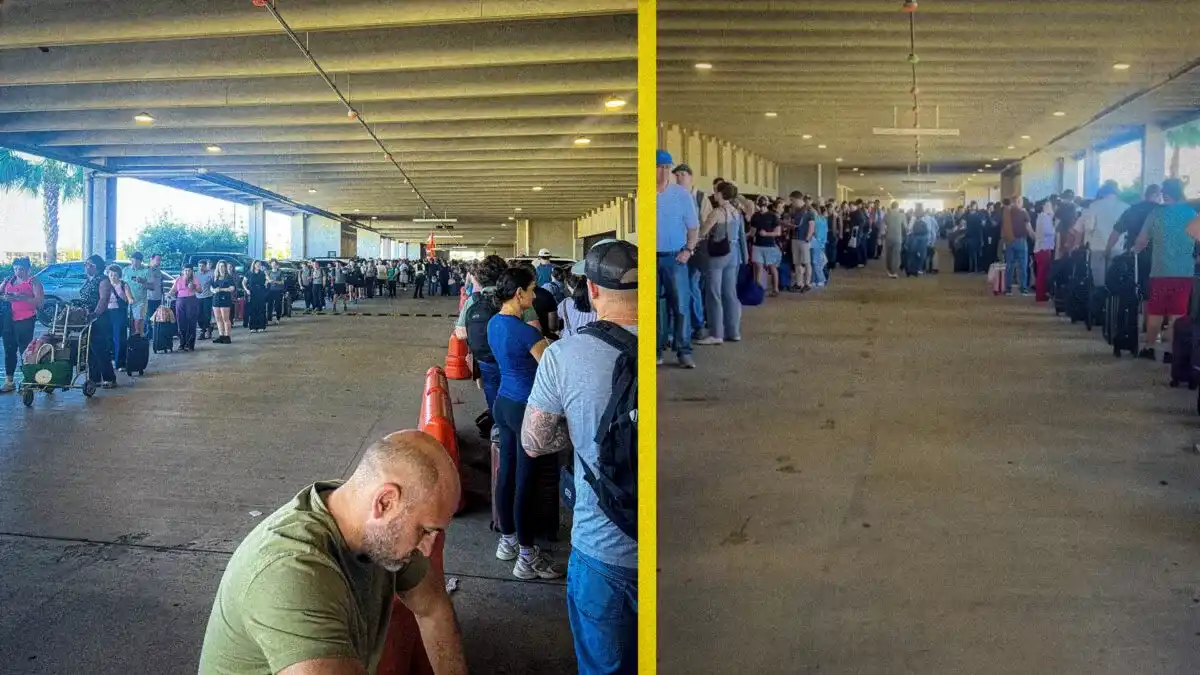
For the United States, which has almost no high-speed rail network and heavily relies on air travel, turbulence in the civil aviation system is deadly. Even Musk publicly expressed willingness to personally pay the salaries of affected TSA employees.
Also starting in March, the prediction market Polymarket launched a weekly updated "This week's number of delayed flights in the US" prediction event—traders can bet on how many flights will be delayed each week, with the opportunity to earn money if their prediction is correct and lose everything if wrong.
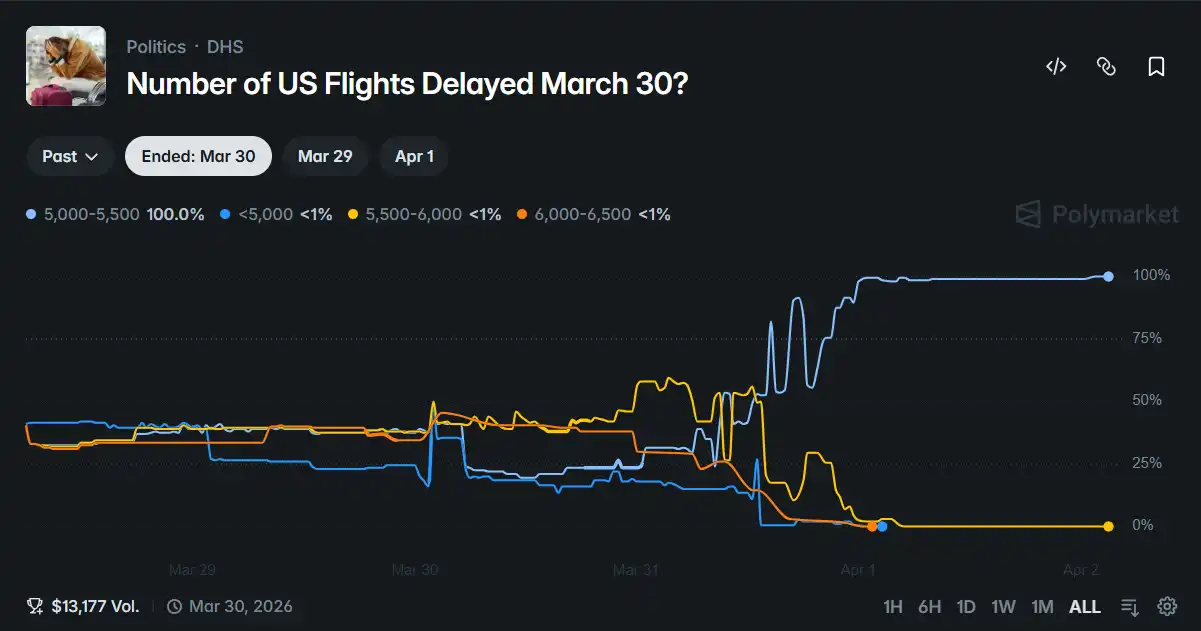
In addition to this purely entertainment-based event, Polymarket has also launched several topics of significant reference value. Through the probabilities reflected by these topics, we can attempt to interpret the current state of the government shutdown and even domestic affairs in the United States.
The Shutdown Game Between the Two Parties
This shutdown has already broken Trump's previous record of 35 days. In the embarrassing situation of widespread flight delays and the near-collapse of the security system, the most concerning question for the affected population within the United States is when the shutdown will end.
Currently on Polymarket, there is already a related event: "DHS Shutdown will end by ___." As of the time of writing, the probability of the shutdown ending between April 5th and 8th is 9%, and the probability of the shutdown not ending in April is 44%.
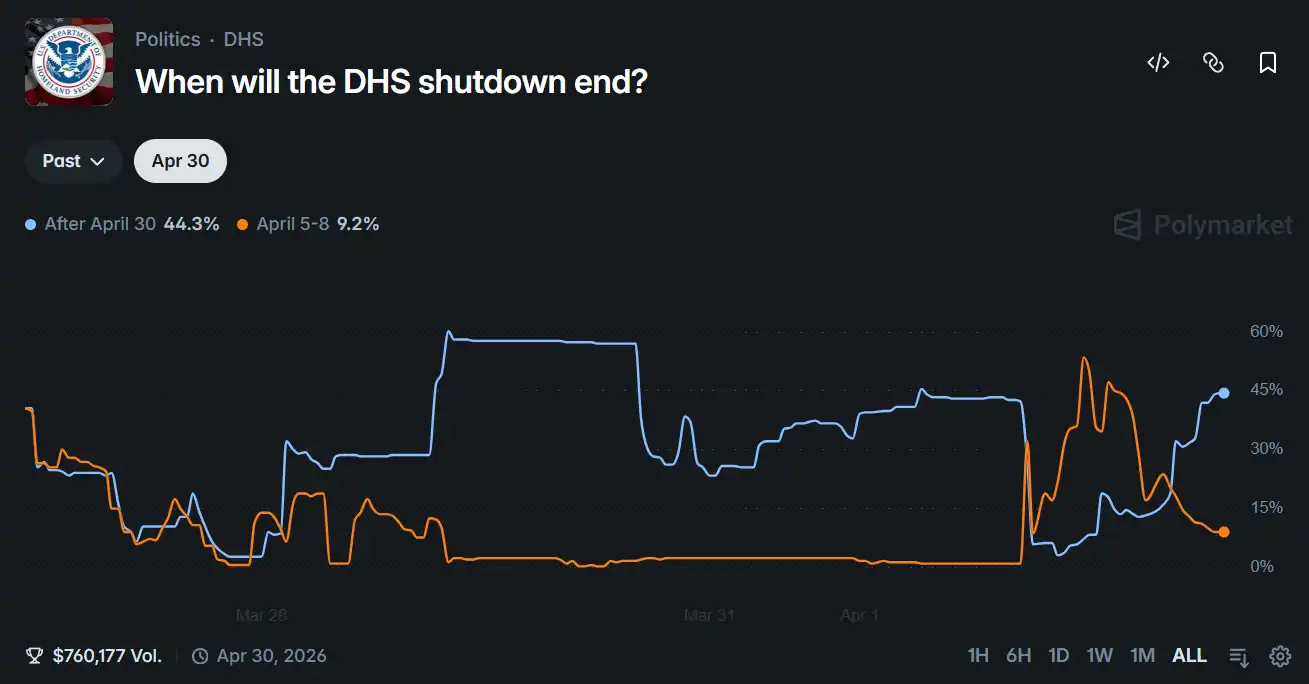
Many "smart money" has been placed on these two time points—senior traders with high accuracy in past predictions and outstanding profitability in the political sector. Behind such trading profiles, it confirms a clear logic: if the shutdown does not end within the April 5th to 8th window, the likelihood of reaching an agreement this month will significantly decrease.
April 5-8 coincides with Congress returning to work after a break, and the two parties will once again put the appropriations bill on the table. If they can reach an agreement in the days following their return to work and the bill is passed by both the Senate and the House, the shutdown will come to an end.
However, if this window is missed once again, the Senate and the House will then be caught up in other scheduling matters. Without strong political pressure, the motivation for both parties to return to the negotiating table will significantly weaken.
Musk's "Tab" and ICE's "Overtime"
Due to ongoing TSA staff shortages causing severe delays at major airports, Musk tweeted on March 21 that he was willing to pay TSA workers' salaries, giving rise to the Polymarket trading event "Will Musk pay TSA staff salaries?".
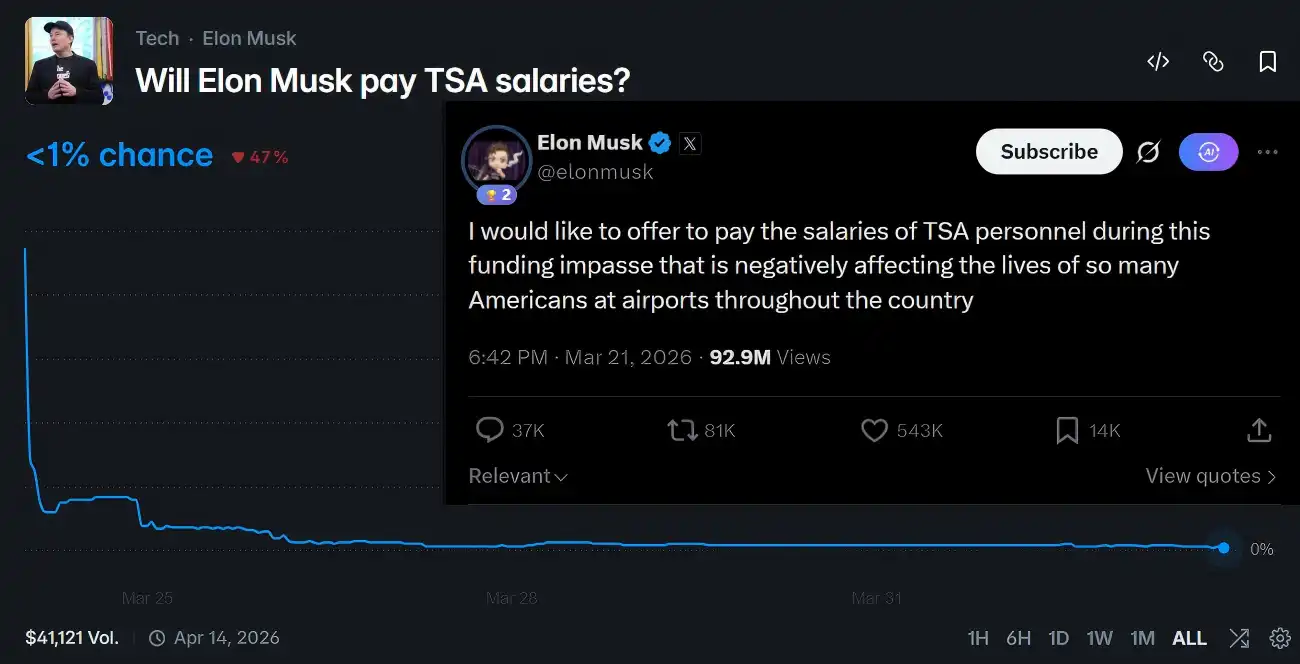
However, shortly after Musk's tweet, the White House rejected the proposal citing legal compliance and conflicts of interest: under U.S. federal law, government employees cannot accept external compensation related to their official duties; furthermore, Musk's deep involvement in federal government contracts presents a significant conflict of interest in directly paying wages.
While there is legal basis for the rejection, ordinary people still have to live. To minimize the impact of the aviation system's paralysis on the midterm elections, in March, Trump ordered the deployment of Immigration and Customs Enforcement (ICE) agents to airports to replace TSA workers who had resigned due to unpaid leave.
However, the scene that unfolded after these ICE agents arrived at the airport made the entire shutdown situation look even more absurd.
Since taking office, ICE has been aggressively downsizing recruitment and training processes to achieve the goal of "arresting 3,000 people daily and deporting millions annually" – planning to hire an additional ten thousand law enforcement officers and shortening the original 16-week physical training to 8 weeks.

In short, the professionalism of these ICE agents themselves is already questionable.
Yet TSA's security work requires systematic training, covering core skills such as X-ray machine operation and explosive detection, which ICE agents simply do not possess.
Thus, a historic scene unfolds: TSA workers are volunteering on the job while also showing ICE agents the security screening process and teaching them how to maintain order. Most ICE agents are not performing actual security screening but are patrolling the terminals, using their law enforcement status to interrogate and deport suspected undocumented immigrants.

The data confirmed the outcome of this farce: After ICE was deployed to the airport, the flight delay situation did not significantly improve. As of the end of March, the U.S. aviation system still experienced thousands of flight delays per day on average, with nearly a 40% TSA absenteeism rate at the Atlanta airport and over 350 flight delays in a single day. These numbers indicate that the ICE agents, who were supposed to act as a shutdown cushion, did not play the role that everyone expected.
The "Nuclear Option" to Break the Deadlock
Another transaction event related to this government shutdown is "Will the Republican Party use the 'nuclear option' to break obstruction by December 31, 2026?", with the current probability at 31%.
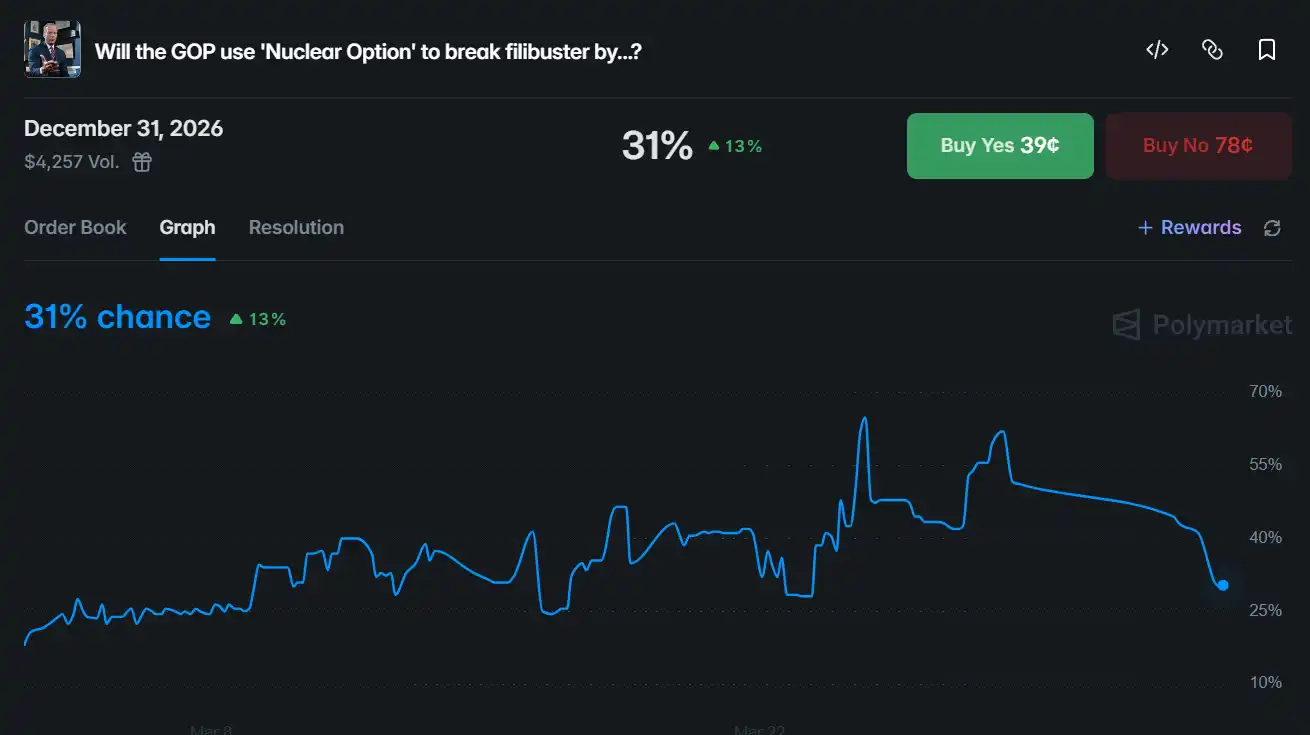
At first glance, the term "nuclear option" may seem intimidating; however, in the U.S. political arena, it is not a literal nuclear weapon but rather one of the few yet highly destructive bargaining chips the Republican Party holds.
In the U.S. legislative system, the House of Representatives is responsible for proposing and drafting fiscal appropriation bills, while the Senate is responsible for deliberation and voting. Typically, ending debate and advancing to a vote in the Senate requires the support of 60 votes — meaning the minority party only needs 41 votes to indefinitely delay debate and block any bill.
The "nuclear option" provides a way to bypass this threshold: a senator can make a procedural appeal to overturn the presiding officer's ruling with a simple majority (51 votes), thus forcibly lowering the vote threshold required to end debate from 60 votes.
Currently, the Republican Party holds 53 seats in the Senate, and once the nuclear option is triggered, the Democrats' ability to obstruct will be nearly nonexistent.
However, the reason it's called the "nuclear" option is that it comes with a high cost to the user: breaking Senate procedural rules would be seen as an abuse of power by voters; more importantly, if the Republican Party loses the majority in the future, the same rules could be used by the Democrats to retaliate.
The hole dug today may need to be filled by the digger tomorrow. The 31% probability is the market's true pricing of this dilemma.
Amidst this ongoing shutdown deadlock, Trump also finds himself dealing with the escalating situation in Iran.
On one side, there is a high-stakes diplomatic and military game, while on the other side, there are airport queues, unpaid wages, and interparty wrangling — the troubles that this U.S. administration needs to coordinate are far more numerous than what the headlines suggest. Internal and foreign crises never wait for each other to be resolved first.
Amid this turmoil, the rich landscape of political and current events prediction markets will continue to act as an objective mirror, helping us capture the true trajectory of these narratives.
You may also like

Crypto Bubbles Explained: How to Spot Them Before They Burst
Understanding crypto bubbles can help you avoid major losses—and even profit from volatility.

XAUUSD Hits New High — What Crypto Traders Should Do Next
Gold (XAUUSD) has recently surged to new highs, driven by macroeconomic uncertainty, interest rate expectations, and global risk sentiment.

Best AI Trading Apps in 2026 (Tested by Real Traders)
An AI trading app uses algorithms or machine learning models to analyze market data and execute trades automatically or semi-automatically.

Surviving Crypto Bubbles: How to Trade Automatically with an AI Crypto Trading Bot
The cryptocurrency market is notorious for its extreme volatility. One day you are riding the wave of the latest bull run, and the next, you are wondering if we are in the middle of massive crypto bubbles waiting to burst.
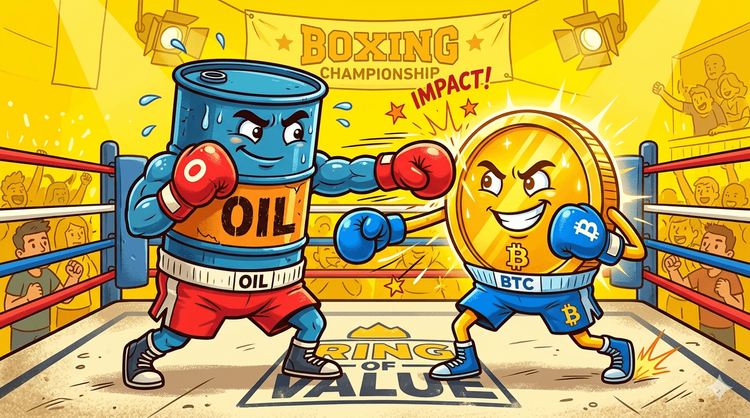
How the US-Iran War Could Affect Oil and Bitcoin Prices (Latest Analysis)
The outbreak of the US-Iran war on February 28, 2026, has provided an unprecedented real-time laboratory for understanding how geopolitical oil shocks interact with an increasingly institutionalized cryptocurrency market. This article examines the relationship between crude oil prices and Bitcoin throughout the conflict, analyzing price movements, correlation patterns, and the underlying transmission mechanisms.

OpenAI Wants to Write Its Own Rules|Rewire News Brief

Chaos Labs Exits, Who Will Pick Up Aave's Risk?
Stealthy Financial War? Iran Collects Strait Transit Fees in Stablecoin

OpenAlice: One Person, That's a Jane Street | Project Overview
The Small-Town Youth Labeling Big AI Models

Morning Report | Strategy increased its holdings by 4,871 BTC last week; Toss plans to develop its own blockchain and issue a native cryptocurrency; OpenAI's CFO privately questioned the timing of the IPO in 2026

Research: Stablecoins have a trading volume of 35 trillion a year, how much of it is real payment?

Galaxy Research: AI agents are giving rise to new species on the blockchain, how zero-human companies activate the financial flywheel

Data Research: How big is the liquidity gap between Hyperliquid and CME crude oil?

WEEX P2P now supports GHS, ETB & ZAR—Merchant Recruitment Now Open
To make crypto deposits easier, WEEX has officially launched its P2P trading platform and continues to expand fiat support. We're excited to announce that the Ghana Cedi (GHS), Ethiopian Birr (ETB) and South African Rand (ZAR) are now available on WEEX P2P!
Why Are GPU Prices Skyrocketing Out of Control?

How to Master Claude Cowork Completely?

70-Page Confidential Letter Alleges First Charge of 'Lying,' Altman Tells Board 'I Can't Change My Personality'
Crypto Bubbles Explained: How to Spot Them Before They Burst
Understanding crypto bubbles can help you avoid major losses—and even profit from volatility.
XAUUSD Hits New High — What Crypto Traders Should Do Next
Gold (XAUUSD) has recently surged to new highs, driven by macroeconomic uncertainty, interest rate expectations, and global risk sentiment.
Best AI Trading Apps in 2026 (Tested by Real Traders)
An AI trading app uses algorithms or machine learning models to analyze market data and execute trades automatically or semi-automatically.
Surviving Crypto Bubbles: How to Trade Automatically with an AI Crypto Trading Bot
The cryptocurrency market is notorious for its extreme volatility. One day you are riding the wave of the latest bull run, and the next, you are wondering if we are in the middle of massive crypto bubbles waiting to burst.
How the US-Iran War Could Affect Oil and Bitcoin Prices (Latest Analysis)
The outbreak of the US-Iran war on February 28, 2026, has provided an unprecedented real-time laboratory for understanding how geopolitical oil shocks interact with an increasingly institutionalized cryptocurrency market. This article examines the relationship between crude oil prices and Bitcoin throughout the conflict, analyzing price movements, correlation patterns, and the underlying transmission mechanisms.


 App
App