
「Transition Period」 Discussion Escalates Panic, US Stocks Once Again Drag Down Bitcoin

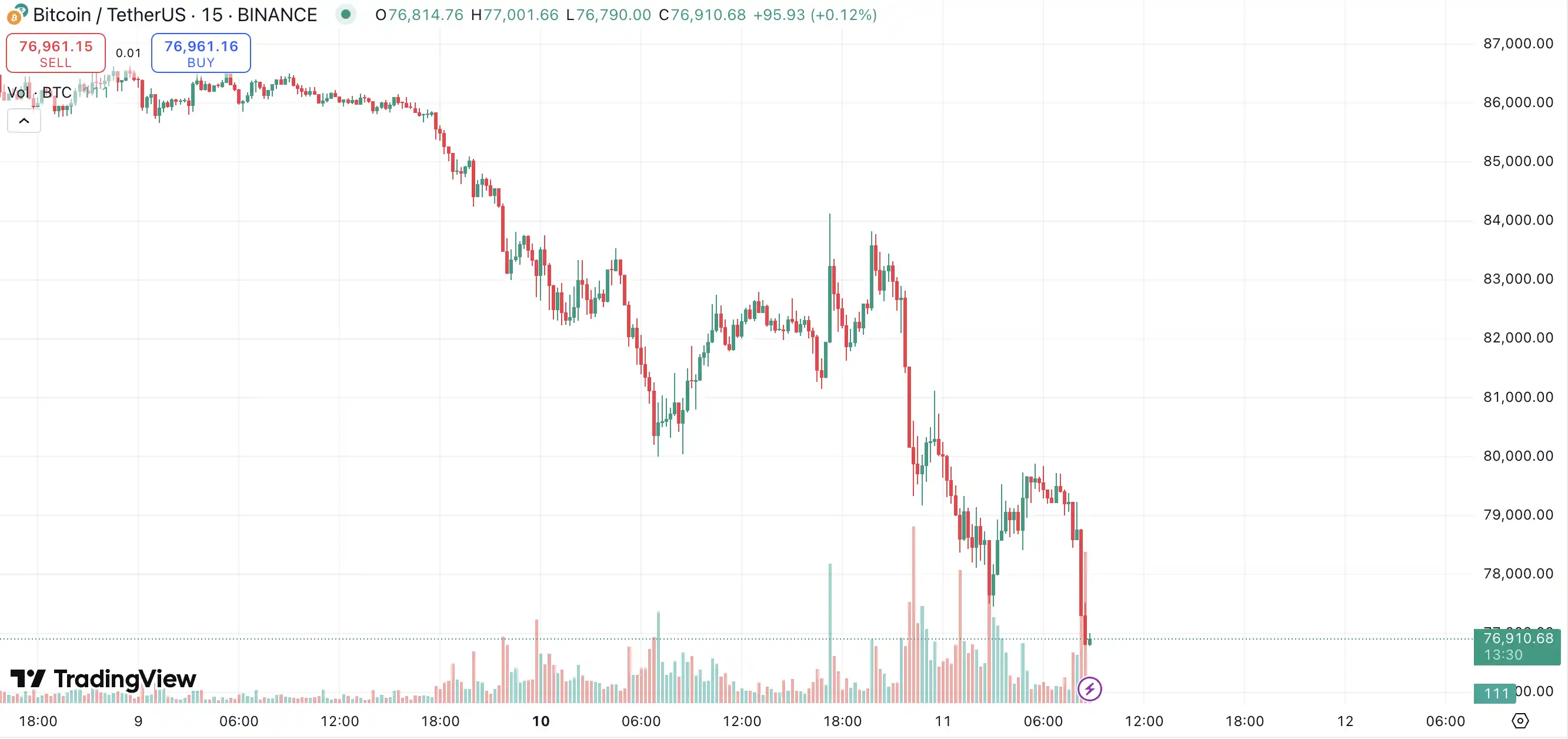
Last night, Bitcoin continued to plummet, falling to touch $76,650, now priced at $77,600, a 4.5% drop in 24 hours, hitting a new low since November 2023.
According to Coinglass data, the Ethereum network's total liquidation amount in the past 12 hours reached $765 million, with long liquidations at $674 million and short liquidations at $91.21 million.
Since March, the total market value of the cryptocurrency sector has been continuously declining, dropping to $2.6 trillion as of the time of writing, now priced at $2.62 trillion, with a 24-hour drop of 7%.
Investor Confidence Severely Divided under Tariff Threat
U.S. President Trump's recent intensive adjustments to tariff policies have caused severe market turbulence. Trump signed an executive order on February 1 to impose a 25% tariff on products imported from Mexico and Canada. On February 3, Trump announced a 30-day deferral of the tariff hike measures and continued negotiations. Following this decision, the relevant tariff measures took effect on March 4. However, on March 6, Trump signed amendments to the tariffs on Mexico and Canada, exempting products compliant with the United States-Mexico-Canada Agreement (USMCA) from tariffs until April 2.
On March 7, Trump announced a suspension of tariffs to assist Mexico and Canada, with tariffs to be fully reciprocated starting from April 2. "As time goes by, tariffs may increase."
Related Read: "U.S. Stock Market Evaporates $1.5 Trillion, Cryptocurrency Market Evaporates $300 Billion, Trump Holds an Expensive Press Conference"

Despite the solid fundamentals of the U.S. economy - the latest job data shows an addition of 151,000 jobs with unemployment at a historical low and Fed Chairman Powell emphasizing the economy is in a "good place" - investor confidence has become severely divided.
Trump, in an interview with Fox News, stated that economic policies may cause short-term turbulence, but he believes it will drive future prosperity. "I don't like predicting things like that; what we're doing is very big, so there is a period of transition." Analysts point out that the White House is attempting to pressure the stock market to force the Fed to cut rates, coupled with risks of government shutdown and federal spending reduction, pushing the economy into a "stagflation trap."
Trump chaotically adjusted tariffs and made significant cuts to federal spending, causing the investment market outlook to become increasingly bleak. The market, which had been relying on America's excellent economic performance to rise, experienced a major reversal.
US Stock Market Plunges, Wall Street Panic Intensifies
On March 10, the US stock market's decline deepened, with the S&P 500 index falling by 2.7%, marking the largest single-day drop this year. The tech-heavy Nasdaq index was hit the hardest among major indices, plummeting by 4%, marking its largest single-day drop since September 2022. Tesla saw its largest single-day drop since September 2020, erasing all post-election gains, while Nvidia dropped over 5%. Safe-haven trading drove the defensive utility sector higher.
The US stock market faced multiple adverse factors, including concerns about a US economic recession, escalating trade tensions, risks of a US government shutdown, market expectations of an imminent Japanese rate hike, unwinding of the yen carry trade, breach of key technical indicators, deteriorating market sentiment, and investors turning to safe-haven assets.
The three-week-long market sell-off further intensified, with investors worrying that the uncertainty of chaotic tariff policies could lead to an economic recession. Citigroup analyst Drew Pettit stated, "This large-scale sell-off feels terrible; we had high expectations for growth, and all this sell-off is just a readjustment to the new risks we face."
Morgan Stanley's Chief US Equity Strategist Michael Wilson analyzed, "If economic growth further significantly declines and a recession may occur, the S&P index could drop another 20%." He warned, "We are not there yet, but the situation could change rapidly." As risks increased, funds flowed into safe-haven assets, with short-term bonds rising, and Bitcoin dropping to a four-month low.
Strategic Reserves Turned Empty Talk?
Also on March 7, the crypto industry welcomed the long-awaited Bitcoin Strategic Reserve executive order. Around 8 a.m. on March 7, White House AI and Cryptocurrency Czar David Sacks posted on social media that President Trump had just signed an executive order to establish a strategic Bitcoin reserve. However, after this huge positive news broke, Bitcoin's price immediately plummeted, dropping from around $90,000 to below $85,000 within an hour. With the continued decline in the US stock market, Bitcoin's price naturally followed suit and fell to its lowest point since November 2023 last night.
Related Reading: "Trump Signs Bitcoin Strategic Reserve Executive Order, Why Did the Market Plunge Instead?"
David Sacks wrote in a tweet that the reserve fund will be capital-backed by Bitcoin owned by the federal government, specifically Bitcoin seized by the U.S. government in criminal or civil asset forfeiture proceedings. The U.S. government will not sell any of the Bitcoin deposited into the reserve but is also unlikely to acquire more Bitcoin, meaning "it won't cost taxpayers a dime."
However, at the inaugural White House Cryptocurrency Summit held on Friday evening, no good news was heard in the market. Instead, it broadcasted to the world a certain level of "flattery" in the cryptocurrency market.
Meanwhile, a spokesperson for the UK Treasury stated, "The volatility makes Bitcoin less suitable as a reserve asset for the UK, and the UK has no plans to introduce a Bitcoin reserve like the U.S."
In a best-selling book, the author wrote, "As for cryptocurrency, Spitznagel feels there is too little data, too much noise to accurately assess it now. Taleb is more direct. He says that Bitcoin cannot be a safe haven for investment because it is highly correlated with the market. Just think about the crisis in March 2020 when Bitcoin's decline exceeded the market average. This shows that it has no value as a tool for hedging against market collapse risks."
You may also like

Morning Report | Musk's xAI launches Skills; Duan Yongping to first build position in Circle in Q1 2026; Polymarket partners with Nasdaq to launch prediction market

Vitalik: What is the key to the next phase of Ethereum?

Interlace: A global leader in Agentic Payment and stablecoin infrastructure platform, building the next generation of digital financial foundation

Duan Yongping establishes a position in a cryptocurrency company for the first time: Why Circle?

Recovering cryptocurrency assets is a lucrative business that quietly makes a fortune

Gemini 3.5 is here! Tonight, Google personally eliminates Google
Harvard and other institutions are liquidating their assets, and six core talents have left in a month. What is happening with Ethereum?
The tokenized market will reach a trillion-dollar scale, but there are still four major obstacles

Founder of Baixing.com: We have transformed from leaders in AI to guides in AI

The AI stock god who made 60 times profit bets 7.7 billion dollars on Nvidia reaching its peak

WEEX Crypto Pizza Day: Join Us in Dubai for a Slice of Crypto History

WEEX P2P now supports KES—Merchant Recruitment Now Open

WEEX P2P now supports COP—Merchant Recruitment Now Open
Dialogue with Lead Bank Founder Jackie: American Banks Re-embrace Crypto

Vitalik: What we need to do is not to fight against AI, but to create a sanctuary

Morning News | VanEck and Grayscale submitted BNB ETF amendments on the same day; BlackRock discusses investing billions of dollars in SpaceX's IPO; Michael Saylor releases Bitcoin Tracker information again

Crypto ETF Weekly | Last week, the net outflow of Bitcoin spot ETFs in the United States was $995 million; the net outflow of Ethereum spot ETFs in the United States was $255 million

This Week's News Preview | The Federal Reserve Releases the Last FOMC Minutes of the "Powell Era"
Morning Report | Musk's xAI launches Skills; Duan Yongping to first build position in Circle in Q1 2026; Polymarket partners with Nasdaq to launch prediction market
Vitalik: What is the key to the next phase of Ethereum?
Interlace: A global leader in Agentic Payment and stablecoin infrastructure platform, building the next generation of digital financial foundation
Duan Yongping establishes a position in a cryptocurrency company for the first time: Why Circle?
Recovering cryptocurrency assets is a lucrative business that quietly makes a fortune
Gemini 3.5 is here! Tonight, Google personally eliminates Google