
- Buy Crypto
- Markets
- Futures
- Spot
- Copy Trade
 Earn
Earn- More
The Trump Family's WLFI Project Launches Lending Platform, USD1 Utility Milestone?

Original Title: "DeFi Platforms Also 'Undergo Metamorphosis': Why Did Trump's WLFI Put on the National Bank Coat?"
Original Author: Sanqing, Foresight News
On January 12, a Trump family member project, World Liberty Financial (WLFI), launched the lending platform World Liberty Markets.
Previously, on January 7, WLFI announced that its subsidiary, WLTC Holdings LLC, had submitted an application to the Office of the Comptroller of the Currency (OCC) to establish World Liberty Trust Company, National Association (WLTC), a national trust bank designed for stablecoin operations.
WLFI's USD-pegged stablecoin USD1 achieved a circulating supply of over $3.4 billion within a year (CoinMarketCap data), becoming one of the fastest-growing USD-pegged stablecoins.
Through the federal regulatory system and the liquidity lending market, WLFI is not only seeking applications for USD1 but also attempting to bridge the gap between TradFi and DeFi.
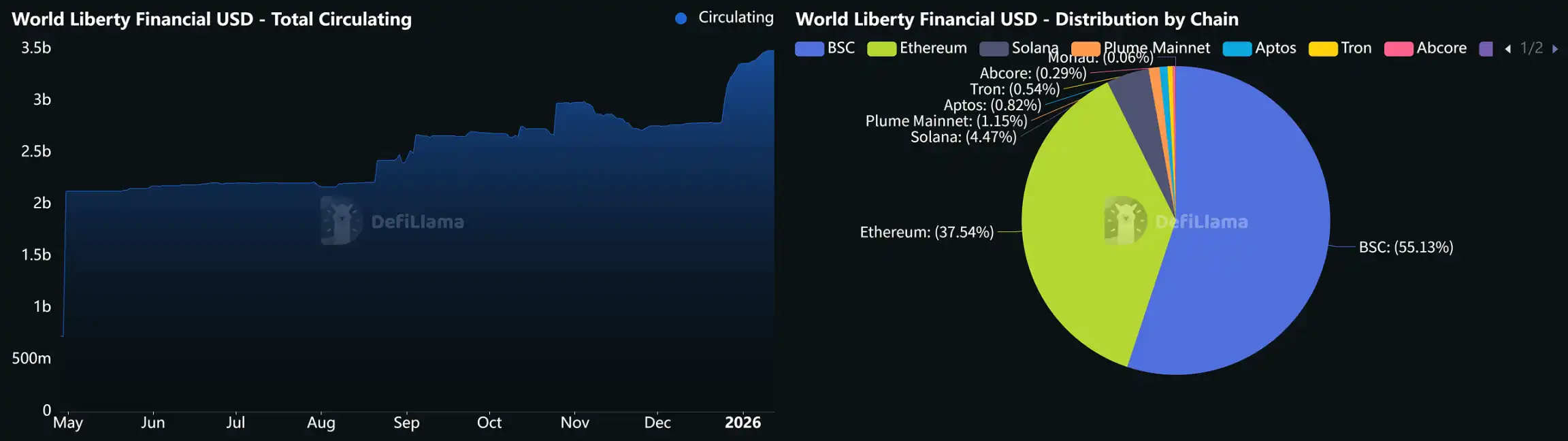
USD1 Total Market Value Curve and Chain Distribution | Source: DeFiLlama
DeFi Lending Platform World Liberty Markets: Practical Landing of USD1
Five days after submitting the licensing application, WLFI's launch of World Liberty Markets marked the entry of its DeFi business into the operational stage. The platform, built on the Dolomite protocol, initially debuted on Ethereum and showed an intention for multi-chain expansion.
World Liberty Markets is positioned as a lending market revolving around USD1. Users can not only deposit assets on the platform to earn interest but also use their held assets as collateral to borrow other tokens.
The lending asset system is centered around USD1 while also accommodating various collaterals such as ETH, USDC, USDT, WLFI, cbBTC, covering mainstream crypto assets and protocol-native tokens. This platform structure caters to both the demand for USD1 stability and provides the liquidity foundation for its presence in DeFi.
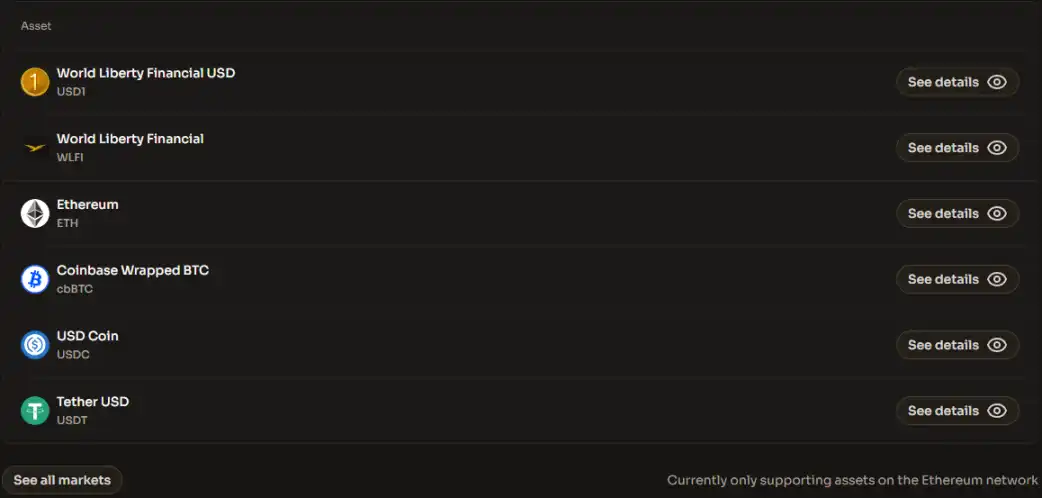
Supported Currencies on WLFI Markets | Image Source: WLFI Website
On the governance side, WLFI token holders have proposal and voting rights, allowing them to make decisions on key matters such as adding new collateral assets, adjusting interest rate parameters, or setting user incentives.
Immediately after the platform's launch, it triggered a market response. Dolomite, as the provider of the underlying protocol architecture, saw its native token DOLO rise by 71.9% on the same day.
Additionally, WLFI also launched early incentive activities to attract initial users by increasing the USD1 deposit yield. According to the WLFI Markets page, the USD1 lending incentive feature is provided by Merkle, with the annualized interest rate updating in real time.
While the regulatory application is still under review, the launch of World Liberty Markets has allowed WLFI to advance its business scenarios. Regardless of the final outcome of the license, USD1 has begun to transition from a concept issuance to on-chain lending use, truly entering the race to compete with the mainstream DeFi ecosystem.
National Trust Bank Charter Application: Stablecoin Business Moving Towards Regulatory Compliance
Through its intended subsidiary World Liberty Trust Company (WLTC), WLFI aims to obtain a national trust bank charter issued by the OCC. If approved, this means that the operation of USD1 will transition from a third-party collaborative model to a federally regulated "full-stack" model.
The envisioned scope of WLTC's business includes directly handling the minting and burning of USD1 without relying on external intermediaries; providing direct exchange services between the US dollar and USD1; and offering regulated custody services for assets like USD1, gradually replacing third-party service providers like BitGo.
The significance of this charter goes far beyond business integration. Obtaining OCC approval means the project is entering a federally regulated system, with profound implications for user trust and institutional adoption.
Currently, Binance has been deeply involved in the creation of USD1 and has added trading pairs, while Coinbase has also listed the asset. This regulatory endorsement can further reduce user concerns, and by embracing federal regulation directly, WLFI can better comply with regulatory requirements such as the GENIUS Act.
The WLFI team also aims to block any potential conflicts of interest through the architecture design. To address potential political scrutiny, WLFI CEO Zach Witkoff stated that the trust company's architecture is designed to avoid conflicts, with neither Trump nor his family members serving as executives or exercising daily control.
Meanwhile, USD1 has been gradually gaining more institutional support, demonstrating its increasing penetration in the industry. Abu Dhabi investment firm MGX previously used USD1 to purchase $2 billion worth of Binance shares, a transaction that also served as a significant external endorsement.
Despite rapid progress, WLFI still faces multiple uncertainties. The OCC's discussion on conflicts of interest during the approval process will be a focal point. While Zach Witkoff emphasizes that the Trump family does not hold executive positions and has no voting rights, the approval of the application remains uncertain in the current highly politically charged environment.
Additionally, although USD1 has grown rapidly, there remains a significant gap in liquidity depth and use cases compared to the two leading stablecoins, USDT and USDC. To further expand, WLFI needs to prove that its advantage lies not only in compliance narratives and endorsements but also in providing a technology experience, capital efficiency, and DeFi composability that are at least equivalent to, if not better than, mainstream products.
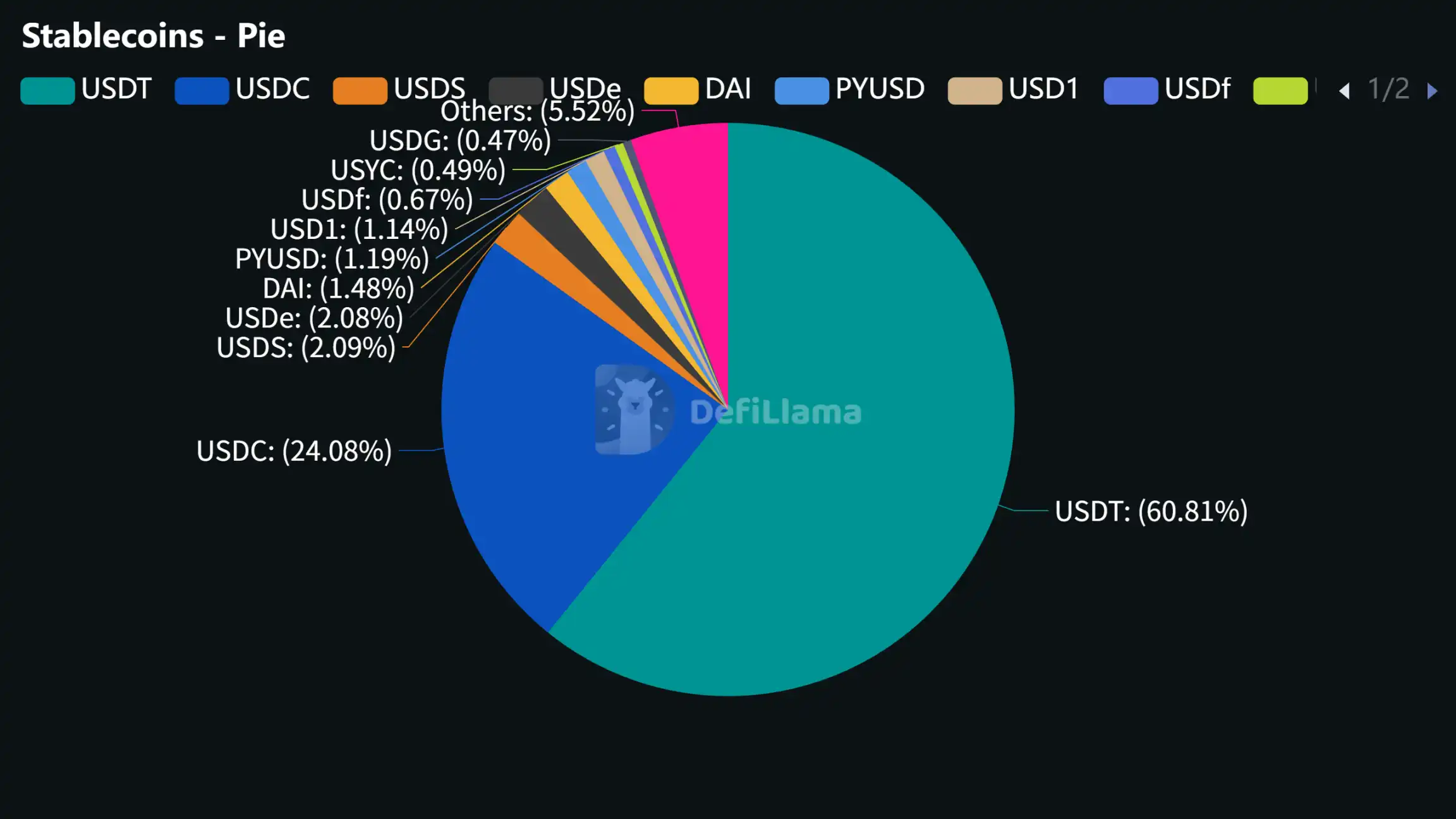
Stablecoin Market Cap Share | Source: DeFiLlama
Relationship Between Licensing and DeFi Lending: Indirect but Strategically Complementary
As the OCC gradually approves companies including Circle, Ripple, BitGo, Paxos, and Fidelity for similar licenses, a regulated cryptocurrency banking system is taking shape.
There is no direct regulatory linkage between the national trust bank license and DeFi lending, but there is a significant indirect boost.
Enhancing USD1's credibility and liquidity in DeFi. The federal regulatory identity endorses USD1, attracting more funds into liquidity pools, thus enhancing the depth and stability of the lending market.
Bridging TradFi and DeFi. The license's fiat onramp reduces user barriers, facilitating traditional users' participation in DeFi lending.
Building a truly closed-loop business ecosystem. In the future, WLFI plans to launch a mobile app, USD1 debit card, and RWA integration (such as tokenized real estate as collateral), all of which will benefit from regulatory clarity and credit endorsement.
You may also like

What Happened in Crypto Today? Solana-Native Rails Launch on Digitap ($TAP) as the Best Crypto to Buy
Key Takeaways Digitap ($TAP) spearheads the transition toward real-world utility in cryptocurrency, offering a seamless financial ecosystem through…

XRP Price Breakdown Intensifies — Can Support Mitigate the Shock?
Key Takeaways XRP has dipped below the significant $1.80 mark, continuing its downtrend. The asset is trading beneath…

Kevin Warsh Associated with Crypto Project Basis and Electric Capital
Key Takeaways Kevin Warsh, former U.S. Federal Reserve Board Governor, is associated with crypto initiatives Basis and Electric…

Mantle’s Cross-Chain Era on Solana: Onboarding the Bybit Express to Mantle Super Portal
Key Takeaways Bybit joins forces with Mantle to enhance cross-chain asset flows through the Mantle Super Portal. Mantle…

$30 Million Heist: Step Finance Treasury Wallets Breached
Key Takeaways Step Finance, a prominent Solana-based DeFi platform, faced a significant security breach, losing approximately $30 million…
Tom Lee–Linked Bitmine Faces Over $6B in Unrealized Losses on ETH Reserve
Key Takeaways: Bitmine Immersion Technologies reports significant unrealized losses exceeding $6 billion from its Ether reserves. The firm…
Ethereum Price Prediction: $2.5B Liquidated as ETH Slides to $2,400 – Is $2,100 Next?
Key Takeaways Over $2.5 billion worth of crypto positions have been liquidated, with Ethereum bearing the brunt of…

Ethereum Price Prediction: Bitcoin Suffers, But $28M Boosts ETH – A Sign of the Flippening?
Key Takeaways Ethereum has experienced a significant price decline of 7.5% recently, touching $2,725, largely due to adverse…

Aster Price Prediction: ASTER Defends $0.60 Support as Bulls Eye $0.74 MA
Key Takeaways Aster’s price is holding firmly at the $0.60 support level despite overall market declines. A breakout…
Optimism Unveils Enterprise Blockchain Infrastructure for Fintechs—Are Banks Ready to Adapt?
Key Takeaways Optimism has introduced OP Enterprise, a blockchain infrastructure providing fintechs and financial institutions with direct control…
Liquid Staking Protocol Lido Introduces stVaults to Boost Ethereum Staking Infrastructure
Key Takeaways stVaults by Lido aim to expand Ethereum’s staking by enabling custom validator configurations for developers. Linea…

qLabs Fires First Shot in Quantum Crypto Race — Can Coinbase Catch Up?
Key Takeaways The rise of quantum computing poses significant security risks to traditional blockchain systems reliant on elliptic…

Vitalik Buterin Withdraws 16,384 ETH as Ethereum Foundation Enters ‘Austerity Phase’ — What For?
Key Takeaways Vitalik Buterin has withdrawn 16,384 ETH, valued at approximately $44.5 million, from the Ethereum Foundation amid…
Left hand to right hand? Unpacking the financial leverage loop behind the AI boom and Wall Street’s ultimate high-stakes bet
For a company that built its brand around “safety,” its greatest historical risk exposure has come from security itself.

Navigating the Complexities of Cryptocurrency Trading
Cryptocurrency trading has surged, attracting diverse investors. Understanding market strategies and trends is crucial for success. Risk management…

Gold Price Prediction as Tom Lee Says Metals Rally Could Hit Crypto
Key Takeaways: Gold recently reached an all-time high of $5,598, reflecting a strong investor shift towards safe-haven assets…

Talos Raises $45M Series B Extension Backed by Robinhood, Bringing Total Funding to $150M
Key Takeaways: Talos, a leading provider of institutional digital asset trading technology, has raised $45 million in a…

Russia Caps Crypto Investments at $4,000 Annually for Non-Qualified Investors – Will Others Follow Suit?
Key Takeaways Russia’s proposal sets a $4,000 annual investment limit for non-qualified crypto investors, sparking discussions on regulatory…
What Happened in Crypto Today? Solana-Native Rails Launch on Digitap ($TAP) as the Best Crypto to Buy
Key Takeaways Digitap ($TAP) spearheads the transition toward real-world utility in cryptocurrency, offering a seamless financial ecosystem through…
XRP Price Breakdown Intensifies — Can Support Mitigate the Shock?
Key Takeaways XRP has dipped below the significant $1.80 mark, continuing its downtrend. The asset is trading beneath…
Kevin Warsh Associated with Crypto Project Basis and Electric Capital
Key Takeaways Kevin Warsh, former U.S. Federal Reserve Board Governor, is associated with crypto initiatives Basis and Electric…
Mantle’s Cross-Chain Era on Solana: Onboarding the Bybit Express to Mantle Super Portal
Key Takeaways Bybit joins forces with Mantle to enhance cross-chain asset flows through the Mantle Super Portal. Mantle…
$30 Million Heist: Step Finance Treasury Wallets Breached
Key Takeaways Step Finance, a prominent Solana-based DeFi platform, faced a significant security breach, losing approximately $30 million…
Tom Lee–Linked Bitmine Faces Over $6B in Unrealized Losses on ETH Reserve
Key Takeaways: Bitmine Immersion Technologies reports significant unrealized losses exceeding $6 billion from its Ether reserves. The firm…


 App
App