
- Buy Crypto
- Markets
 Futures
- Spot
- Copy Trade
- Earn
- More
Is the Shift Away from "Buying the Dip" Strategy the Reason Behind Bitcoin's Recent Drop?

Original Article Title: Why did Bitcoin's largest buyers suddenly stop accumulating?
Original Article Author: Oluwapelumi Adejumo, Crypto Slate
Original Article Translation: Luffy, Foresight News
Throughout most of 2025, Bitcoin's support level seemed unshakable due to the unexpected alliance between Corporate Digital Asset Treasuries (DAT) and Exchange-Traded Funds (ETF), collectively forming the support foundation.
Enterprises acquired Bitcoin through issuing stocks and convertible bonds, while ETF inflows quietly absorbed new supply. Together, they built a robust demand foundation that helped Bitcoin withstand the pressure of a tightening financial environment.
Now, this foundation is beginning to weaken.
On November 3, Charles Edwards, the founder of Capriole Investments, posted on X platform that as institutional accumulation slowed down, his bullish outlook has diminished.
He pointed out: "For the first time in 7 months, institutional net inflows fell below daily mining supply, a concerning development."
Bitcoin Institutional Buying Volume, Source: Capriole Investments
Bitcoin Institutional Buying Volume, Source: Capriole Investments
Edwards stated that even though other assets outperform Bitcoin, this indicator remains a key reason for his optimism.
However, currently, around 188 corporate treasuries hold significant Bitcoin positions, with many companies having a relatively single-focused business model besides Bitcoin exposure.
Bitcoin Treasury Accumulation Slows Down
No company represents corporate Bitcoin trading better than the recently renamed "Strategy," formerly known as MicroStrategy.
Led by Michael Saylor, this software manufacturer has transformed into a Bitcoin treasury company, currently holding over 674,000 bitcoins, securing its position as the world's largest single corporate holder.
However, its buying pace has significantly slowed down in recent months.
In the third quarter, Strategy only increased its Bitcoin holdings by about 43,000 coins, the lowest quarterly purchase amount this year. Considering that the company's Bitcoin purchases during this period plummeted to only a few hundred coins, this number is not surprising.
CryptoQuant analyst J.A. Maarturn explained that the slowdown in accumulation may be related to Strategy's Net Asset Value (NAV) decline.
He stated that investors had previously paid a high "NAV premium" for each $1 of Bitcoin on Strategy's balance sheet, essentially allowing shareholders to benefit from Bitcoin's price appreciation through leverage. However, this premium has significantly narrowed since mid-year.
With the dwindling valuation premium, issuing new shares to purchase Bitcoin no longer brings significant appreciation, and the incentive for corporate financing to increase holdings has decreased accordingly.
Maarturn pointed out: "The funding difficulty has increased, and the stock issuance premium has dropped from 208% to 4%."
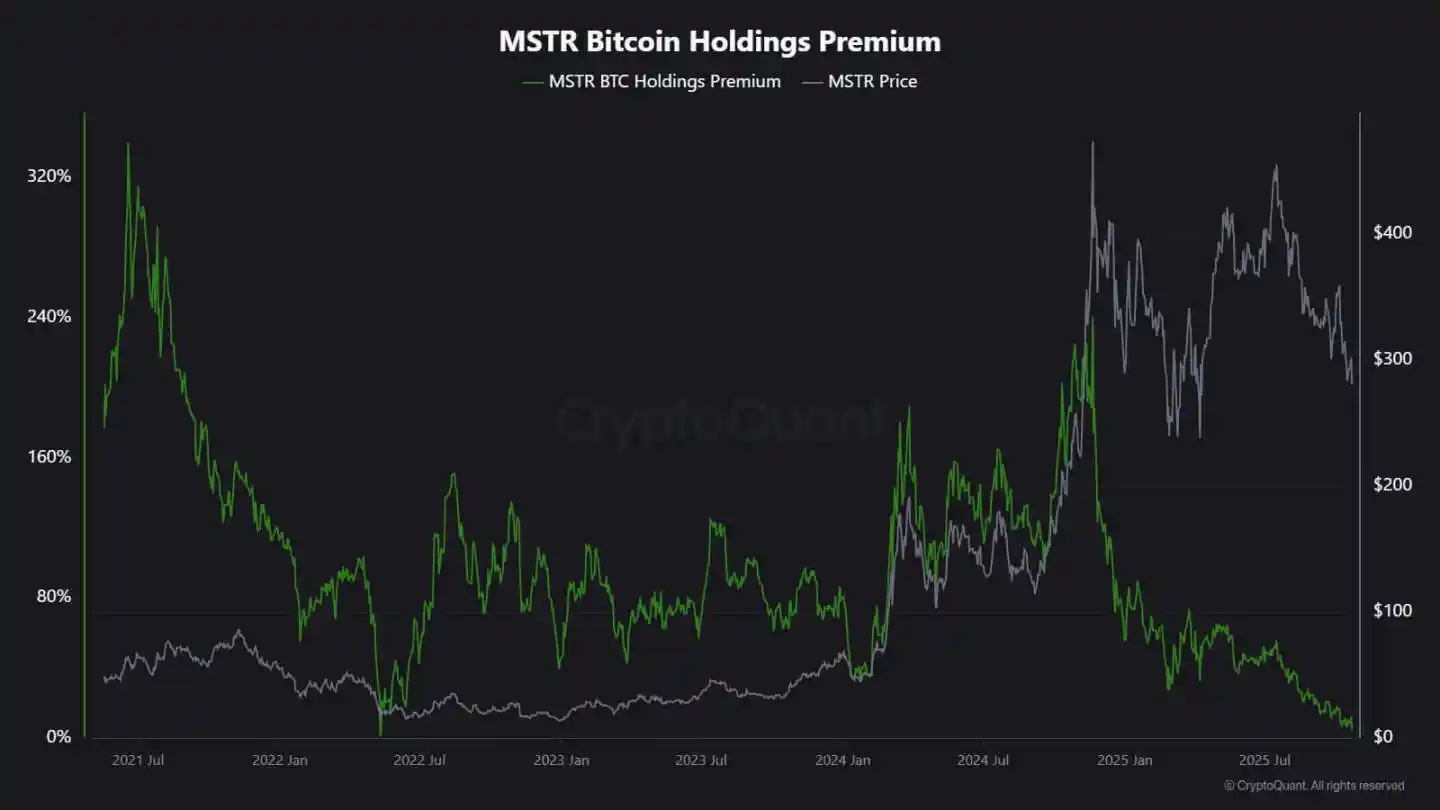
Strategy Stock Premium, Source: CryptoQuant
Meanwhile, the cooling trend in accumulation is not limited to Strategy.
Tokyo-listed company Metaplanet previously followed the model of this U.S. pioneer, but after a significant drop in the stock price, the recent trading price is below its Bitcoin holdings' market value.
In response, the company approved a stock repurchase plan and introduced new funding guidance to expand its Bitcoin treasury. This move demonstrates the company's confidence in its balance sheet, but also highlights that investors' enthusiasm for the "crypto treasury" business model is waning.
In fact, the slowdown in Bitcoin treasury accumulation has led to some corporate mergers.
Last month, asset management firm Strive announced the acquisition of smaller-scale Bitcoin treasury company Semler Scientific. After the merger, these companies will hold nearly 11,000 Bitcoins.
These cases reflect structural constraints rather than wavering beliefs. When stock or convertible bond issuance no longer commands a market premium, capital inflows dry up, and corporate accumulation naturally slows down.
How Are ETF Flows Doing?
Long seen as the "New Supply Absorber," the spot Bitcoin ETF has also shown similar signs of weakness.
Throughout much of 2025, these financial investment tools dominated net demand, with subscription volume consistently outpacing redemption volume, especially during Bitcoin's surge to an all-time high.
However, by late October, their fund flows became unstable. Influenced by interest rate expectations, portfolio managers adjusted positions, risk departments reduced exposure, and some weekly fund flows turned negative. This volatility marked a new phase of behavior for Bitcoin ETFs.
The macro environment has tightened, hopes for rapid rate cuts have gradually faded, and liquidity conditions have cooled. Nevertheless, the market demand for Bitcoin exposure remains strong but has shifted from "steady inflows" to "pulsed inflows."
SoSoValue's data clearly reflects this shift. In the first two weeks of October, cryptocurrency asset investment products attracted nearly $6 billion in inflows; however, by the end of the month, with redemptions exceeding $20 billion, some of the inflows were wiped out.

Bitcoin ETF Weekly Fund Flows, Source: SoSoValue
This pattern indicates that Bitcoin ETFs have matured into a true two-way market. They can still provide deep liquidity and institutional access channels but are no longer just one-way accumulation tools.
When macro signals fluctuate, ETF investors' exit speed may be just as rapid as their entry speed.
Market Impact on Bitcoin
This shift does not necessarily mean that Bitcoin will experience a decline, but it does indicate increased volatility. As the absorption capacity of corporations and ETFs weakens, Bitcoin's price trajectory will be increasingly influenced by short-term traders and macro sentiment.
Edwards believes that, in this scenario, new catalysts—such as monetary easing, regulatory clarity, or a return of stock market risk appetite—could reignite institutional buying.
However, at present, marginal buyers are more cautious, making price discovery more sensitive to the global liquidity cycle.
The impact is primarily manifested in two aspects:
First, the structural buy orders that once served as support are diminishing. During periods of insufficient absorption, intraday volatility may intensify as there is a lack of stable buyers to curb volatility. The halving in April 2024 technically reduced new supply, but without sustained demand, scarcity alone cannot guarantee price increases.
Second, Bitcoin's correlated features are shifting. As the balance sheet accumulation cools off, the asset may once again follow overall liquidity cycle dynamics. Periods of rising real rates and a strong dollar could create price pressure, while loose conditions could see it reestablishing leadership in risk-on rallies.
Essentially, Bitcoin is re-entering a macro reflexivity phase, behaving more like a high-beta risk asset rather than digital gold.
At the same time, all this does not negate Bitcoin's long-term narrative as a scarce, programmable asset. Instead, it reflects the increasing influence of institutional dynamics—entities that shielded Bitcoin from retail-driven volatility are now tightening its correlation with broader capital markets, cementing its mainstream portfolio allo-cation.
The coming months will test whether Bitcoin can hold its store of value characteristics in the absence of corporate and ETF auto-matic inflows.
By historical analogy, Bitcoin has often exhibited adaptability. As one demand channel wanes, another emerges—whether from sovereign reserves, fintech integration, or retail re-engagement in a macro easing cycle.
You may also like

Gold Plunges Over 4%, Silver Crashes 11%, Stock Market Plummet Triggers Precious Metals Algorithmic Selling Pressure?

Coinbase and Solana make successive moves, Agent economy to become the next big narrative

Aave DAO Wins, But the Game Is Not Over

Coinbase Earnings Call, Latest Developments in Aave Tokenomics Debate, What's Trending in the Global Crypto Community Today?
ICE, the parent company of the NYSE, Goes All In: Index Futures Contracts and Sentiment Prediction Market Tool

On-Chain Options: The Crossroads of DeFi Miners and Traders

How WEEX and LALIGA Redefine Elite Performance
WEEX x LALIGA partnership: Where trading discipline meets football excellence. Discover how WEEX, official regional partner in Hong Kong & Taiwan, brings crypto and sports fans together through shared values of strategy, control, and long-term performance.

Best Crypto to Buy Now February 10 – XRP, Solana, Dogecoin
Key Takeaways XRP is set to revolutionize cross-border transactions, potentially reaching $5 by the end of Q2 with…

Kyle Samani Criticizes Hyperliquid in Explosive Post-Departure Market Commentary
Key Takeaways: Kyle Samani, former co-founder of Multicoin Capital, publicly criticizes Hyperliquid, labeling it a systemic risk. Samani’s…

Leading AI Claude Forecasts the Price of XRP, Cardano, and Ethereum by the End of 2026
Key Takeaways: XRP’s value is projected to reach $8 by 2026 due to major institutional adoption. Cardano (ADA)…

Bitcoin Price Prediction: Alarming New Research Cautions Millions in BTC at Risk of ‘Quantum Freeze’ – Are You Ready?
Key Takeaways Quantum Threat to Bitcoin: The rise of quantum computing presents a unique security challenge to Bitcoin,…
XRP Price Prediction: Could XRP Ultimately Surpass Bitcoin and Ethereum?
Key Takeaways XRP has maintained a strong position despite a recent 12% drop, suggesting potential for growth. Analyst…

Best Crypto to Buy Now February 6 – XRP, Solana, Bitcoin
Key Takeaways The cryptocurrency market is experiencing pressure due to a technology-sector selloff, affecting digital assets like Bitcoin.…

South Korea Broadens Crypto Market Investigation Following Bithumb’s $44 Billion Bitcoin Error
Key Takeaways South Korea intensifies scrutiny on cryptocurrency exchange operations after Bithumb’s significant Bitcoin transaction error. Regulatory bodies,…
Tom Lee-Supported Bitmine Dominates 3.6% of Ethereum Supply Post-Price Crash
Key Takeaways Bitmine Immersion Technologies now controls 3.6% of Ethereum’s total supply after strategic purchases during market downturns.…

XRP Yearly Returns Hit Record Low Since 2023
Key Takeaways XRP’s yearly returns are at their lowest since 2023, as the crypto market grapples with a…

BTC Traders Eye $50K as Potential Bottom: Key Metrics to Monitor This Week
Key Takeaways Traders are closely monitoring the potential bottom for Bitcoin at $50,000 as recent price movements suggest…

Fraudulent ‘XRP’ Issued Token Sparks Confusion on the XRP Ledger
Key Takeaways An imposter XRP token is causing bewilderment within the XRP community by being superficially identical to…


 App
App