
 Buy Crypto
- Markets
 Futures
- Spot
- Copy Trade
- Earn
- More
If the US and Iran have not reached an agreement in 5 days, what other cards does Trump have?

On March 23, Trump announced a 5-day postponement of the strike on Iran's energy infrastructure, claiming there had been "very good, productive dialogue" and "significant points of agreement" between the US and Iran. Following the news, Brent crude oil dropped from $112 to $99.94, a one-day plummet of 10.92%, marking the largest single-day drop since the start of Epic Fury.
However, Iranian Speaker Ghalibaf denied that any direct negotiations had taken place that day. Turkey, Egypt, and Pakistan acted as intermediaries to relay messages, with Kushner and Wittkov coordinating, but there was a disagreement on whether actual talks were happening.
On the Iran issue, this was not the first time Trump had issued a "final warning" and then backed down. From 2018 to the present, a similar pattern has emerged 7 times.
7 Threats, 2 Fulfillments
Looking at all significant threats Trump has made to Iran from 2018 to date, the pattern is clear.
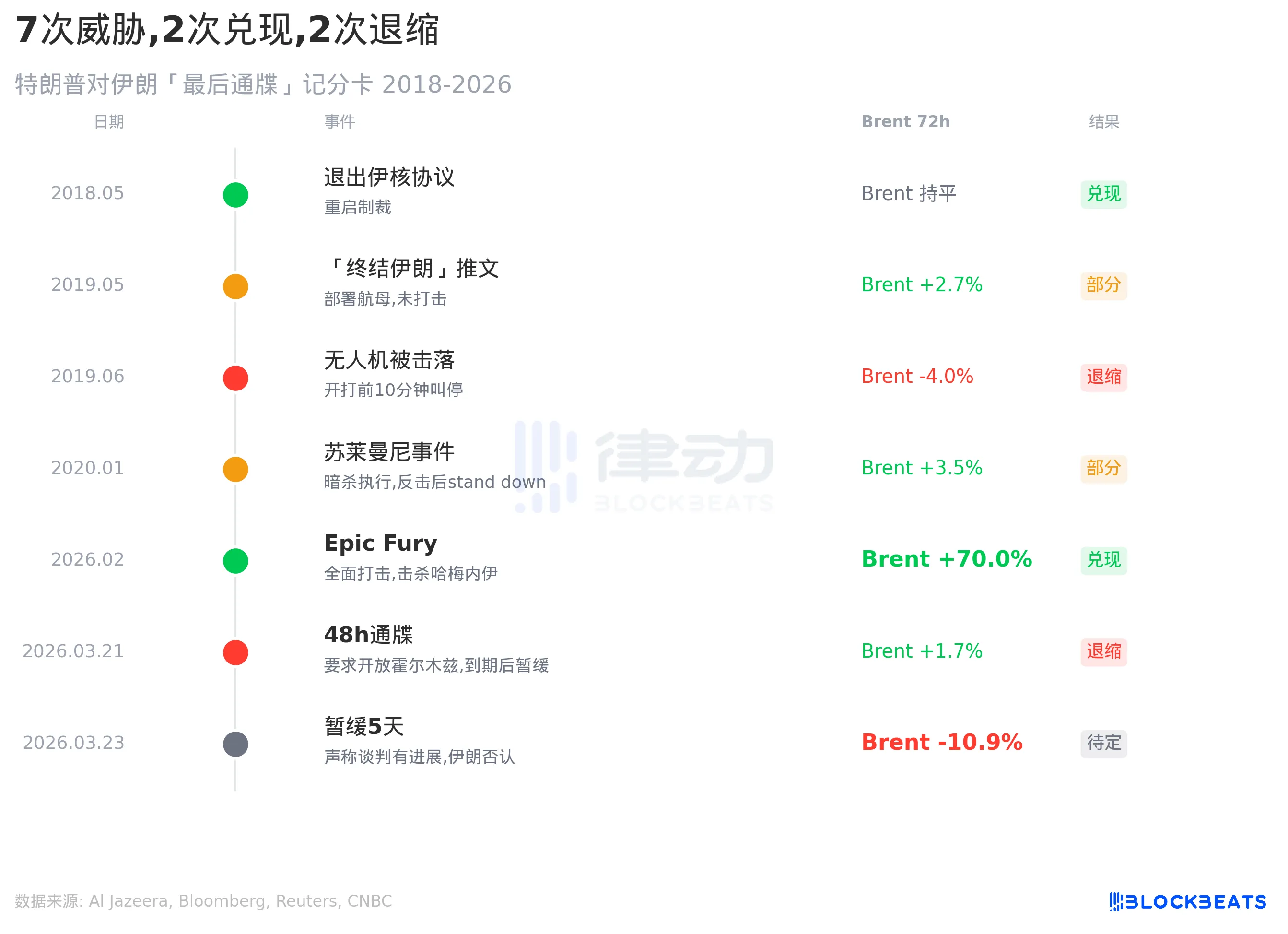
In 2018, he withdrew from the Iran nuclear deal, as promised, and sanctions were reinstated as scheduled. In February 2026, he launched Epic Fury, also following through, killing Soleimani within 24 hours and destroying over 70% of Iran's missile launchers (according to Israeli intelligence assessment). These two instances were completely fulfilled, resulting in a sharp oil price reaction. Epic Fury caused Brent to soar from $71 to $119.50, a 70% increase.
However, the flip side is equally noteworthy. In June 2019, after Iran shot down a US drone, Trump ordered strikes on Iranian radar and missile sites, with the military "cocked and loaded," but called off the strike 10 minutes before it commenced. On March 21, 2026, a 48-hour ultimatum was issued to Iran to reopen the Strait of Hormuz, but instead of an attack after the deadline, it turned into a "5-day postponement."
Out of the 7 instances, 2 were fully carried out, 2 were partially executed, 2 were retreated from, and 1 is pending. The market reaction has also varied. After the halted strike in 2019, the oil price only fell by 3-5%. This time, with a 5-day postponement, the oil price directly dropped by 10.92%. The market's response to signals of "postponement" is intensifying, as investors are increasingly quick to price in the "devaluation of threats."
What Does a $100 Oil Price Signify
After the 5-day window expires, there are three possible scenarios.
The first scenario is reaching some framework agreement. It may not be a comprehensive agreement, more likely a temporary freeze of 30-60 days to buy time for further negotiations. In this scenario, Brent may fall back to the $80-90 range, approaching Goldman Sachs' 2026 average price forecast of $85.
Secondly, postpone and continue to negotiate. After the 5-day deadline expires with no deal or signature, enter a new deferment window. Oil prices remain range-bound between $95-110, with the war risk premium neither dissipating nor intensifying.
Thirdly, resume strikes along with a continued blockade of the Strait of Hormuz. According to CSIS's scenario model, if Iran were to escalate attacks on Gulf oil facilities following a strike, Brent could spike to $130-150. Goldman Sachs's extreme scenario is more aggressive: if the Hormuz blockade persists for 60 days and Middle East production permanently decreases by 2 million barrels/day, oil prices could surpass the historical high of $147 in 2008.
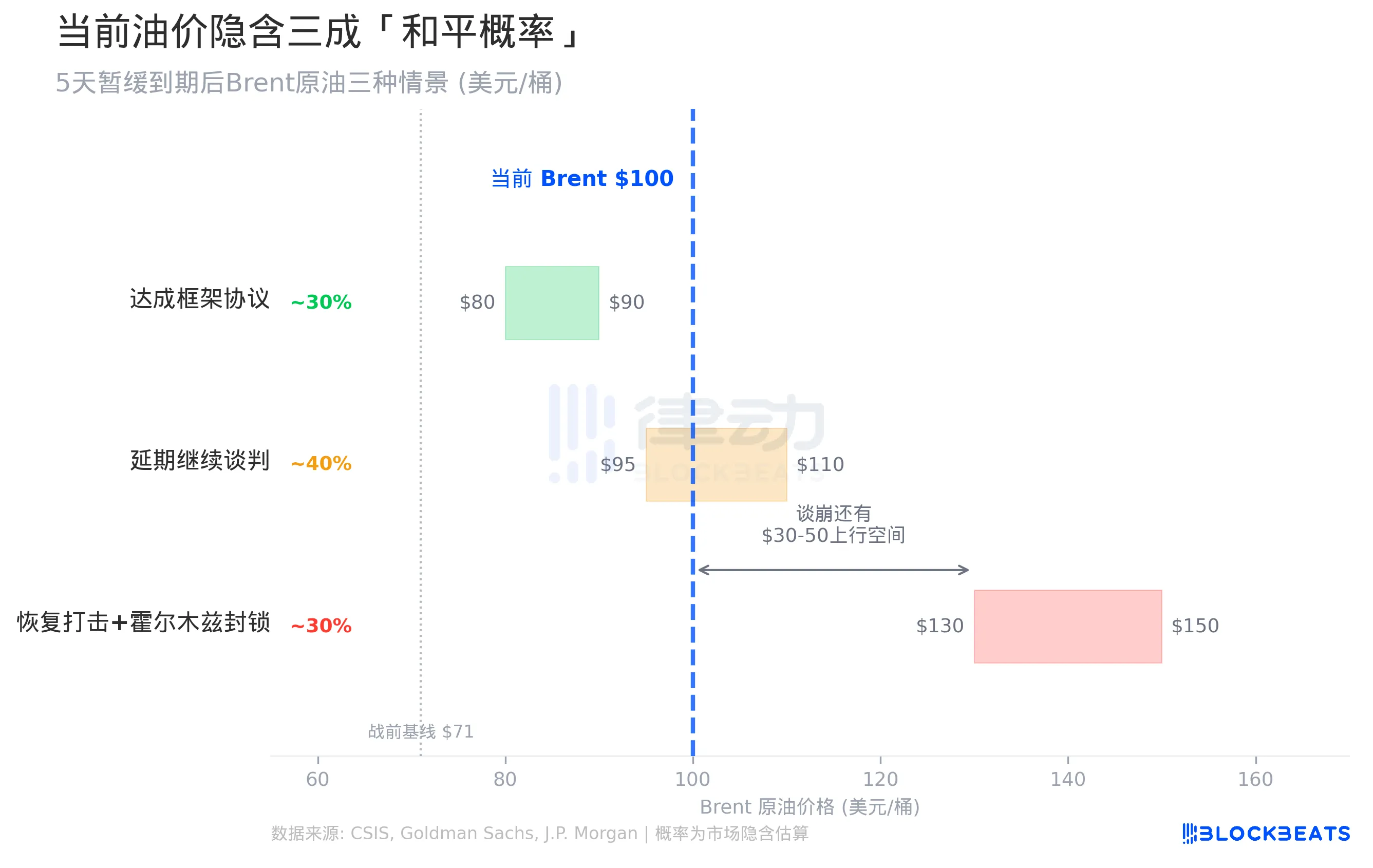
With Brent currently priced at $100, it roughly implies a 30-40% probability of the "deal being reached." In other words, the market believes there is a 60-70% chance that the situation will not fundamentally improve after 5 days. If the talks collapse, oil prices could have upside potential of $30-50.
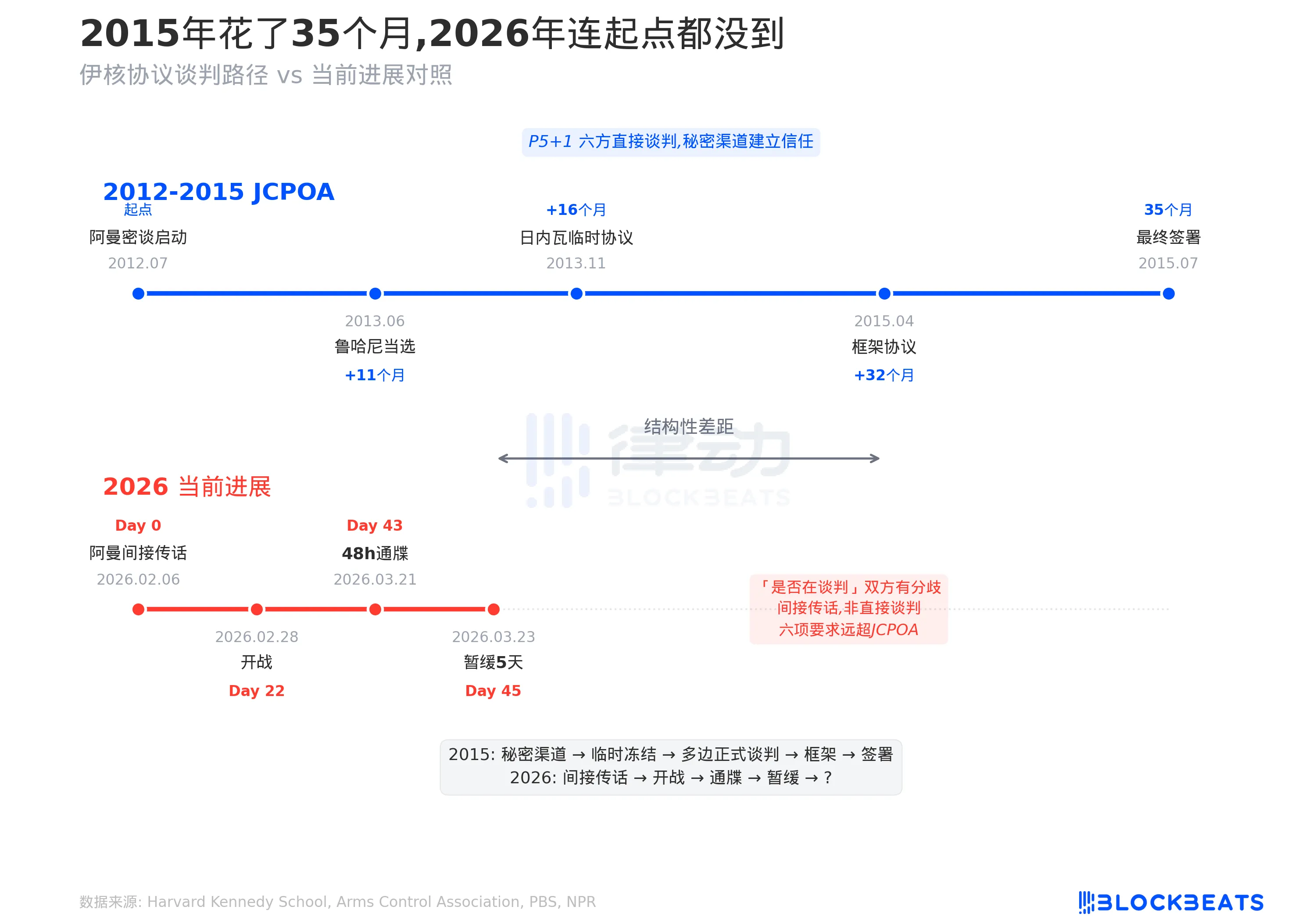
The 2015 Negotiations Took 35 Months
Trump's six core demands include zero uranium enrichment, dismantling nuclear facilities, a 5-year freeze on missile development, ending support for proxy militias, recognizing Israel's right to exist, and having the U.S. physically take over Iran's high-enriched uranium stockpile. These demands far exceed the 2015 JCPOA framework, which only limited enrichment levels to 3.65%, kept facilities operational, and did not involve missiles or proxy militias.
The 2015 JCPOA, from the July 2012 secret talks in Oman to the final signing in Vienna, took a total of 35 months. It went through pragmatic elements coming to power due to Rouhani's election, building trust through the Geneva Interim Agreement, and 20 rounds of direct talks among the P5+1 nations.
Where do things stand in 2026? There was an indirect message in Oman on February 6, followed by war breaking out on February 28. By March 23, just 45 days later, the temporary ceasefire is in place, with both sides contradicting whether they are even in talks. The mediatory structure involves Turkey, Egypt, and Pakistan shuttling messages instead of the P5+1 engaging in multilateral direct negotiations. The prerequisite conditions for talks (acknowledgment by both sides of the talks' existence) have not been met, whereas the 2015 path first established over a year of trust through a covert channel before entering open negotiations.
If Talks Fail, What Other Cards Does Trump Have?
The military option is the most direct. A power plant strike is a 5-day direct target with the lowest threshold for recovery operations. More escalated options include a blockade or occupation of Kharg Island, reportedly discussed in a plan as of March 20, according to Al Jazeera. Kharg processes 90% of Iran's crude oil exports, around 1.3-1.6 million barrels per day (according to EIA data). Regarding nuclear facilities, Natanz was damaged in the first week of the war, Fordow still holds high-enriched uranium unrelocated since its strike in June 2025 (per FDD analysis), but the new Pickaxe Mountain facility built by Iran 100 meters under a granite mountain near Natanz is beyond airstrike capabilities. Currently, the U.S. has deployed 2 carrier strike groups, over 16 surface ships, and more than 100 aircraft in the Middle East, as reported by Military Times, marking the largest scale since the Iraq War in 2003.
On the economic front, Trump declared a 25% tariff in January on countries doing business with Iran. The main targets are China (which accounts for over 90% of Iran's oil trade), as well as India, the UAE, and Turkey. Iran's current oil exports stand at 1.5-1.6 million barrels per day, with daily revenue around $140 million (based on Defense News data).
Cyber warfare is already underway. According to Foreign Policy, prior to the kinetic strike of Epic Fury, the U.S. Cyber Command had already initiated "non-kinetic effects," paralyzing some of Iran's communication and early warning systems.
However, Iran also holds its counterplay cards. As assessed by the U.S. Defense Intelligence Agency (DIA), Iran could sustain a blockade of the Strait of Hormuz for 1-6 months. The strait sees 20 million barrels of crude oil and petroleum products pass through daily, accounting for 20% of global oil consumption (per EIA data), while Saudi Arabia and the UAE only have a pipeline bypass capacity of 3.5-5.5 million barrels per day, leaving a gap of up to 14.5 million barrels per day. Iran still has about 1,500 ballistic missiles and 200 launchers (as estimated by the Israeli military), and Hezbollah is believed to have around 25,000 missiles (per Israeli assessments).
This is the underlying logic of the 5-day window power play. Trump faces a credibility trap: to strike would risk spiraling oil prices and domestic economic pressure. Not to strike would further erode the pricing power of military threats in the cycle of ultimatums and deferrals. Iran's dilemma is symmetrical: to negotiate would be opposed by domestic hardliners. Not to negotiate could lead to the next targets being power plants and Kharg Island. The deadline of March 28 is not the endpoint but the next turn of this trap.
You may also like

From x402 to MPP: Cloudflare's crucial vote, will it go to Coinbase or Stripe?

BlackRock CEO issues annual open letter: The wave of tokenization has arrived, and we will lead this trend

When Backpack backstabs the community

When gold is no longer a safe haven, and Bitcoin continues to panic

Trump, the World's Largest Oil Trader

Tether Whale Dumps £12 Million, Backing Crypto’s ‘British Trump’

Ethereum Foundation Post: Rethinking the Division of Work Between L1 and L2 to Build the Ultimate Ethereum Ecosystem

Two Major Prediction Market Platforms Unite Rarely, What Is the Story Behind This New Fund?
Dragonfly Partners: Most agents will not engage in autonomous trading, how can crypto payments prevail?

US AI Startup Goes All In on Chinese Mega-Model | Rewire News Morning Brief

Trump Lies Again: A "Five-Day Pause" Psyop, How Wall Street, Bitcoin, and Polymarket Insiders Synced Uposciogen

When a Token Becomes Labor, People Become the Interface

Ceasefire News Leaked Ahead of Time? Large Polymarket Bets on Outcome Before Trump's Tweet
BlackRock CEO's Annual Shareholder Letter: How is Wall Street Using AI to Keep Profiting from National Pension Funds?

Sun Valley Releases 2025 Financial Report: Bitcoin Mining Revenue Reaches $670 Million, Accelerating Transformation to AI Infrastructure Platform
On March 16, 2026, in Dallas, Texas, USA, CanGu Company (New York Stock Exchange code: CANG, hereinafter referred to as "CanGu" or the "Company") today announced its unaudited financial performance for the fourth quarter and full year ended December 31, 2025. As a btc-42">bitcoin mining enterprise relying on a globally operated layout and dedicated to building an integrated energy and AI computing power platform, CanGu is actively advancing its business transformation and infrastructure development.
• Financial Performance:
Total revenue for the full year 2025 was $688.1 million, with $179.5 million in the fourth quarter.
Bitcoin mining business revenue for the full year was $675.5 million, with $172.4 million in the fourth quarter.
Full-year adjusted EBITDA was $24.5 million, while the fourth quarter was -$156.3 million.
• Mining Operations and Costs:
A total of 6,594.6 bitcoins were mined throughout the year, averaging 18.07 bitcoins per day; of which 1,718.3 bitcoins were mined in the fourth quarter, averaging 18.68 bitcoins per day.
The average mining cost for the full year (excluding miner depreciation) was $79,707 per bitcoin, and for the fourth quarter, it was $84,552;
The all-in sustaining costs were $97,272 and $106,251 per bitcoin, respectively.
As of the end of December 2025, the company has cumulatively produced 7,528.4 bitcoins since entering the bitcoin mining business.
• Strategic Progress:
The company has completed the termination of the American Depositary Receipt (ADR) program and transitioned to a direct listing on the NYSE to enhance information transparency and align with its strategic direction, with a long-term goal of expanding its investor base.
CEO Paul Yu stated: "2025 marked the company's first full year as a bitcoin mining enterprise, characterized by rapid execution and structural reshaping. We completed a comprehensive adjustment of our asset system and established a globally distributed mining network. Additionally, the company introduced a new management team, further strengthening our capabilities and competitive advantage in the digital asset and energy infrastructure space. The completion of the NYSE direct listing and USD pricing also signifies our transformation into a global AI infrastructure company."
"As we enter 2026, the company will continue to optimize its balance sheet structure and enhance operational efficiency and cost resilience through adjustments to the miner portfolio. At the same time, we are advancing our strategic transformation into an AI infrastructure provider. Leveraging EcoHash, we will utilize our capabilities in scalable computing power and energy networks to provide cost-effective AI inference solutions. The relevant site transformations and product development are progressing simultaneously, and the company is well-positioned to sustain its execution in the new phase."
The company's Chief Financial Officer, Michael Zhang, stated: "By 2025, the company is expected to achieve significant revenue growth through its scaled mining operations. Despite recording a net loss of $452.8 million from ongoing operations, mainly due to one-time transformation costs and market-driven fair value adjustments, the company, from a financial perspective, will reduce its leverage, optimize its Bitcoin reserve strategy and liquidity management, introduce new capital to strengthen its financial position, and seize investment opportunities in high-potential areas such as AI infrastructure while navigating market volatility."
The total revenue for the fourth quarter was $1.795 billion. Of this, the Bitcoin mining business contributed $1.724 billion in revenue, generating 1,718.3 Bitcoins during the quarter. Revenue from the international automobile trading business was $4.8 million.
The total operating costs and expenses for the fourth quarter amounted to $4.56 billion, primarily attributed to expenses related to the Bitcoin mining business, as well as impairment of mining machines and fair value losses on Bitcoin collateral receivables.
This includes:
· Cost of Revenue (excluding depreciation): $1.553 billion
· Cost of Revenue (depreciation): $38.1 million
· Operating Expenses: $9.9 million (including related-party expenses of $1.1 million)
· Mining Machine Impairment Loss: $81.4 million
· Fair Value Loss on Bitcoin Collateral Receivables: $171.4 million
The operating loss for the fourth quarter was $276.6 million, a significant increase from a loss of $0.7 million in the same period of 2024, primarily due to the downward trend in Bitcoin prices.
The net loss from ongoing operations was $285 million, compared to a net profit of $2.4 million in the same period last year.
The adjusted EBITDA was -$156.3 million, compared to $2.4 million in the same period last year.
The total revenue for the full year was $6.881 billion. Of this, the revenue from the Bitcoin mining business was $6.755 billion, with a total output of 6,594.6 Bitcoins for the year. Revenue from the international automobile trading business was $9.8 million.
The total annual operating costs and expenses amount to $1.1 billion.
Specifically, they include:
· Revenue Cost (excluding depreciation): $543.3 million
· Revenue Cost (depreciation): $116.6 million
· Operating Expenses: $28.9 million (including related-party expenses of $1.1 million)
· Miner Impairment Loss: $338.3 million
· Bitcoin Collateral Receivable Fair Value Change Loss: $96.5 million
The full-year operating loss is $437.1 million. The continuing operations net loss is $452.8 million, while in 2024, there was a net profit of $4.8 million.
The 2025 non-GAAP adjusted net profit is $24.5 million (compared to $5.7 million in 2024). This measure does not include share-based compensation expenses; refer to "Use of Non-GAAP Financial Measures" for details.
As of December 31, 2025, the company's key assets and liabilities are as follows:
· Cash and Cash Equivalents: $41.2 million
· Bitcoin Collateral Receivable (Non-current, related party): $663.0 million
· Miner Net Value: $248.7 million
· Long-Term Debt (related party): $557.6 million
In February 2026, the company sold 4,451 bitcoins and repaid a portion of related-party long-term debt to reduce financial leverage and optimize the asset-liability structure.
As per the stock repurchase plan disclosed on March 13, 2025, as of December 31, 2025, the company had repurchased a total of 890,155 shares of Class A common stock for approximately $1.2 million.

The US AI Startup Is Loving China's Open Source Model

Three Weeks of the US-Iran War: Who's Making Money, Who's Paying the Bill?


 App
App