
 Buy Crypto
- Markets
 Futures
- Spot
- Copy Trade
- Earn
- More
Arthur Hayes New Post: It's Now "No Trade" Time

Original Title: No Trade Zone
Original Author: Arthur Hayes
Translation: Peggy, BlockBeats
Editor's Note: The current market is not in a "directionless" state but has entered a "no-trade zone" created by the dual impact of AI-driven deflation and geopolitical disruptions. The true market sentiment of Bitcoin depends on when the currency supply will passively expand again.
On one hand, AI is reshaping the labor structure, eroding the income and creditworthiness of knowledge workers, transmitting deflationary shocks to the financial system; on the other hand, energy conflicts and geopolitical gamesmanship are forcing countries to increase fiscal spending, hoard resources, and maintain operations through money printing. With rising interest rates and currency supply expansion coexisting, risk assets have experienced sharp differentiation.
A deeper change lies in the monetary system itself. The restructuring around energy channels and settlement pathways has loosened the "dollar-asset" loop, causing gold and the Chinese yuan to passively enter trade settlements in the periphery. This structural shift has not yet become a consensus, but its marginal acceleration is already sufficient to affect market expectations.
In this environment, Bitcoin is no longer a single-logic asset. It is both under pressure from deleveraging and liquidity contraction, and benefits from the expectation of currency expansion and credit rebuilding. Therefore, its price performance appears contradictory on the surface but actually reflects the tug-of-war between two systems.
Instead of rushing to make directional bets, author Arthur Hayes is more inclined to wait for a signal—when volatility truly spirals out of control and liquidity is forcibly released, the market will re-enter a "tradable" phase. Until then, this place seems more like an area that requires restrained action.
This is precisely the starting point of this article: in a world of simultaneous deflation and money printing, the market may be experiencing a rare "no-trade zone."
The following is the original text:
Due to the lack of trading action by Maelstrom in the first quarter, some of our brokers occasionally ask me about my views on the market and if there is anything they can do for us. My usual reply is: "It's a no-trade zone right now."
Other than slowly increasing our Hyperliquid position, we barely made any trades throughout the entire first quarter.
Two factors have converged to create a trading "dead zone," at least for our long-only position.
Firstly, there is the rapid spread of agentic AI (or what I call "claws") with autonomy. This type of technology will destroy the career prospects of ordinary knowledge workers under the "flexible employment" structure in the developed Western economies (mainly within the "American Order," i.e., the Pax Americana system). The ensuing result will be a deflationary financial collapse. I have discussed this in detail in my previous article "This Is Fine."
Secondly, following the publication of that article, U.S. President Donald J. Trump, the "Emperor/Showman," took the initiative to wage war on Iran to turn it into the latest "Trashcanistan." He received support from his bellicose yet slightly embarrassed "sidekick," Israeli Prime Minister Benjamin Netanyahu (the "Butcher of Budapest").
The war has been ongoing for nearly seven weeks, and now the only truly important issue is: how the bulk commodities and goods transit around the Strait of Hormuz will be reorganized.
When discussing war or geopolitics, I always like to start by saying: I'm just a skiing goofball, a crypto enthusiast who listens to house music and does the two-step dance. I know nothing about war, nor do I have any inside information about what global leaders will or will not do.
But what I can do is: decipher mainstream propaganda narratives and, with the help of my AI tools, perform some basic calculations using public data. I try to filter out the noise and focus only on the variables that truly affect my investment portfolio. Fortunately, I do not live in the Levant or the Middle East, so my life and freedom are not directly at risk.
In my relatively simple worldview, there are currently three scenarios worth considering—strictly speaking there are four, but the fourth, namely "nuclear Armageddon," is inherently non-investable, so I won't delve into that.
Next, I will introduce each of these scenarios one by one and analyze how they might affect Bitcoin's price from a more macro perspective.
I don't know the probability of each of these scenarios occurring. But what I really want to figure out is: is there a way to construct an investment portfolio that, at best, can outperform in absolute returns against hydrocarbon energy and its first-order derivatives (such as food and fuel prices); and at worst, even if it doesn't outperform energy prices themselves, can at least deliver relatively better performance compared to all major asset classes.
Scenario One: Return to Normalcy
In this scenario, the war quickly ends, and the pre-war status quo is mostly restored. However, a longer-term trend will not change: the accelerated replacement of high-cost knowledge workers with more affordable, efficient AI agents to handle those "operand symbol" tasks.
The U.S. economy is most vulnerable in this process, as about 70% of its GDP comes from consumer spending. Consumers foot the bill for their consumerism through bank credit, and these loans make up the assets on the bank's balance sheet. Once the debt-servicing capacity of ordinary knowledge workers evaporates, these banks will be functionally insolvent and will have to rely on large-scale central bank "money printing" to stay afloat.
Scenario Two: Tehran Toll Booth
In this scenario, the U.S. military either unwilling or unable to stop Iran's restriction of traffic through the Strait of Hormuz.
Iran follows through on its promise: allowing passage of vessels from "friendly nations" but requiring a $2 million "toll fee" to be paid in renminbi, cryptocurrency, sanctioned U.S. dollars, or other diplomatic settlement arrangements.
In the most disadvantageous situation for the "Pax Americana" financial hegemony, countries must find ways to acquire renminbi. However, due to most countries having a trade deficit with China, the only realistic path to obtain a sufficient amount of renminbi is to sell off U.S. assets (such as U.S. Treasuries or tech stocks), buy physical gold, and then exchange the gold for renminbi through the Shanghai or Hong Kong gold markets.
Among the top ten economies in the world by GDP, only Brazil and Russia maintain a trade surplus with China, ranking ninth and tenth respectively. In contrast, the "Pax Americana" itself is the world's largest economy with the largest trade deficit, relying on an equally massive capital account surplus to sustain itself.
However, as countries begin to sell off U.S. assets in exchange for renminbi or fill the commodity gap in the spot market at highly elevated prices, this capital surplus is mathematically destined to shrink. The U.S., with its highly financialized economic system, depends on foreign capital to finance government spending; once foreign capital diminishes, this system becomes unsustainable.
Ultimately, whether through bond price declines (yield increases) or stock market downturns, the government will be forced to fill the funding gap through "money printing."
Scenario Two Point Five: Stars and Stripes Blockade
A dramatic turn of events occurred when, following the failure of U.S.-Iran negotiations to reach a permanent ceasefire agreement, on Sunday, April 12, Donald J. Trump announced that the U.S. Navy would block all vessels entering or exiting the strait.
This blockade could evolve into a form of "pirate-like tolls," where vessels are compelled to pay fees to both sides, as if offering tribute to both Iran and the U.S., and even having to "shout Allahu Akbar and Hallelujah" to express loyalty. It is also possible that retroactive exemptions will be issued to different countries, turning this blockade into a "Swiss cheese full of loopholes."
However, the core logic remains unchanged: if holding U.S. dollars can no longer guarantee that your assets will not be severely impacted by "pirate-like actions," then why hold U.S. dollars?
Scenario Three: Imperial Counterstrike
In this scenario, the U.S. Air Force and Navy carry out their "core mission": through a punitive long-range strike operation, they destroy the Islamic Revolutionary Guard Corps (IRGC)'s ability to disrupt shipping in the Strait of Hormuz.
The strait has reopened, allowing all vessels to pass through safely without additional fees. With the reestablishment of the "Imperial Order," countries no longer need to use currencies other than the US dollar in the short term, nor do they need to engage in panic buying of commodities at high prices in the spot market.
However, the issue lies in the fact that ending Iran's control of the strait would most likely lead to the complete destruction of the country itself. In Donald J. Trump's words, it means "sending them back to the Stone Age."
Many Americans who grew up with the narrative that "Iran is the world's most evil country" may applaud this tough stance. But if Iran is destroyed in this way, it is highly likely that, in its "last breath," it will fulfill its threat to drag the entire Gulf region's energy and commodity production into the abyss.
At that point, the "spice will no longer flow" (meaning a disruption in the global supply chain), and global central banks will have no choice but to wildly print money amidst a surge in commodity prices to sustain the functioning of the financial system.
If you are in a certain "fragile country," your local currency may experience hyperinflation against the US dollar or the ruble. The United States and Russia will be the only remaining large energy-producing countries with the ability to adjust supply, filling the gap left by a burning Middle East.
What may follow is famine and widespread social unrest.
Therefore, even if your Bitcoin holdings may be worth an "infinite amount" in some kind of fiat currency, if you cannot quickly leave a high-risk area, your survival will still face a serious threat.
Situation Chart
Before analyzing Bitcoin's performance in different scenarios, let's quickly review some "chart materials" to provide more visual data to support the above narrative.
Returning to Normalcy
Given that I have already provided a detailed analysis of this scenario in the article "This Is Fine," here I will directly refer back to some of the charts and data provided at that time.
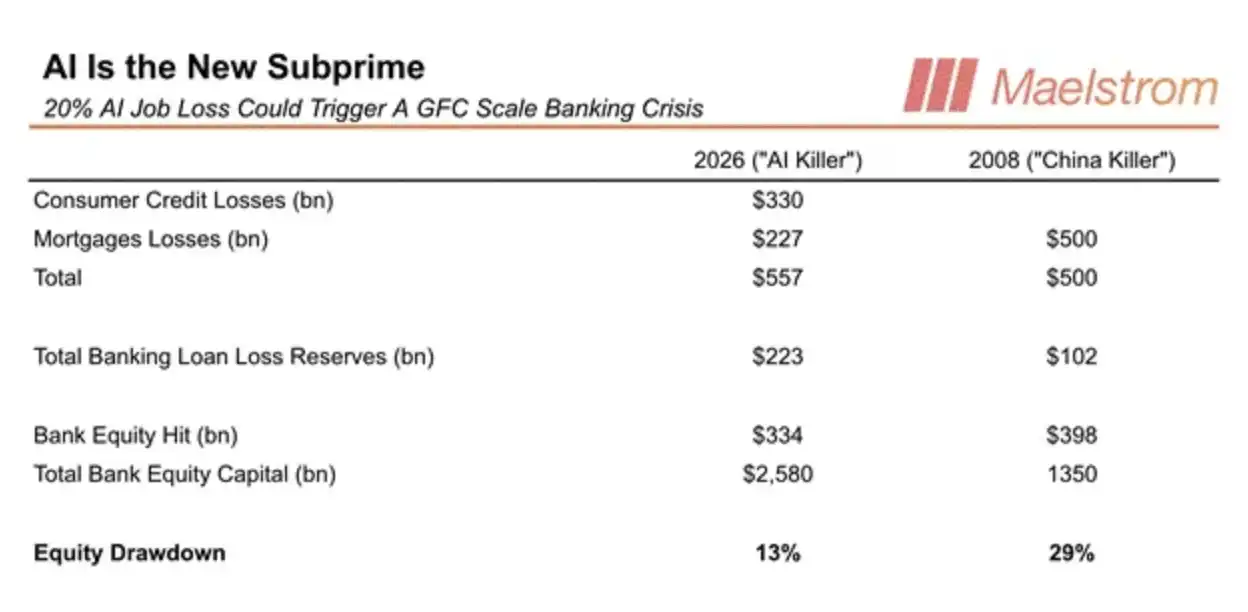
Overall, the deflationary collapse triggered by AI with autonomous agency is as severe as the 2008 US subprime mortgage crisis (2008 Global Financial Crisis).
Currently, the default rate on consumer credit has begun to rise, and a true large-scale wave of layoffs has not even officially started yet.
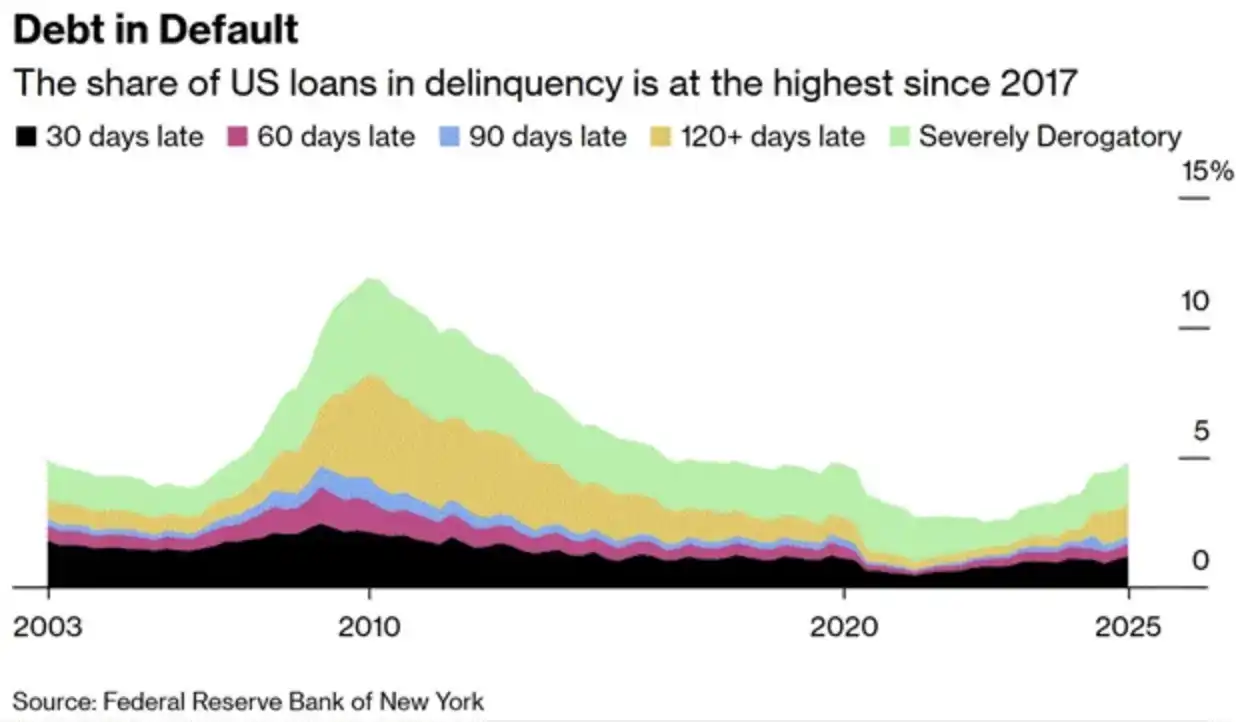
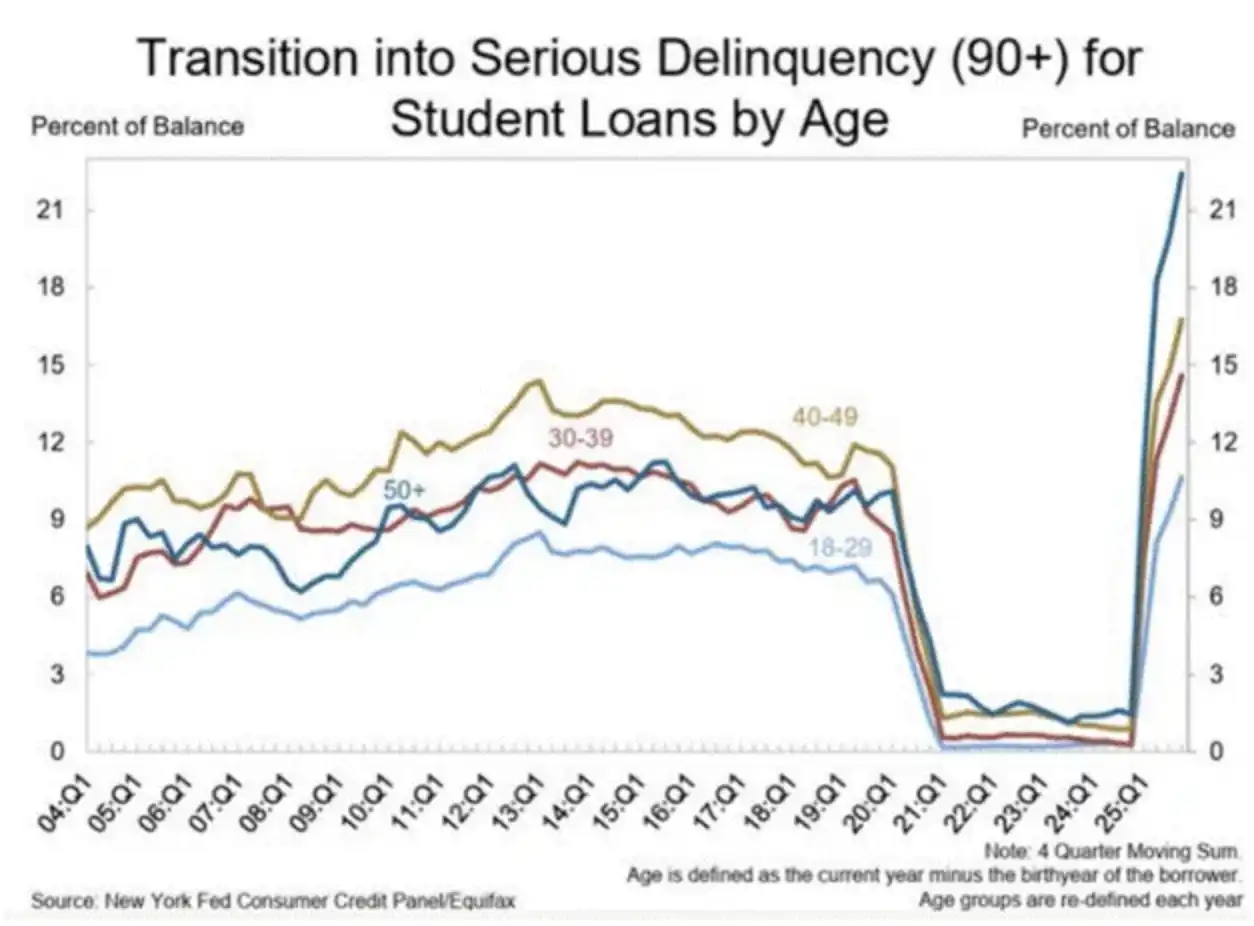
Tehran Toll Booth
Essentially, if this scenario plays out, it would mean the end of the "Petrodollar System" and the rise of a new global reserve currency (or a basket of currencies).
Currently, the Islamic Revolutionary Guard Corps (IRGC) remains quite flexible in terms of payment methods. But if its control over the Strait of Hormuz is truly consolidated, why would it continue to accept dollar payments for passage fees amidst ongoing U.S. restrictions on its dollar usage?
In the end, I believe it will no longer accept dollar settlement. The yuan and gold are likely to become the two core settlement assets in sovereign trade.
If a country has to first exchange gold for yuan, then use yuan to pay passage fees to complete commodity shipments, what reason does it have to continue holding dollars as reserves?
Considering that most major economies have trade deficits with China, the only realistic path to acquire yuan is: sell dollar assets → buy gold → convert gold to yuan.
In such a system, countries will need to hold gold in the future, rather than U.S. Treasuries or other dollar assets like U.S. stocks.
To illustrate the expanding use of the yuan in trade settlement, I would like to reference some charts shared by Luke Gromen. These charts demonstrate the quiet formation of a "Quasi–Gold Standard" system.
Step One: Sell Dollar Assets (such as U.S. Treasuries) and Buy Gold Instead
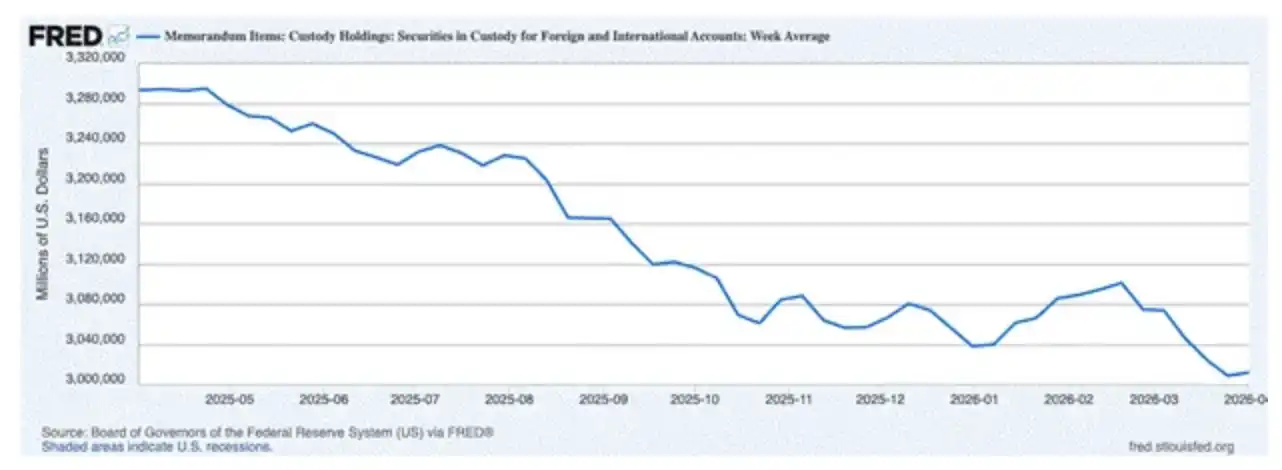
Since the outbreak of war, from a net perspective, foreign holdings of securities in custody with the Federal Reserve have decreased by $63 billion. I use this data as a "directional indicator" to assess overall foreign investors' positioning changes in U.S. Treasuries and other dollar assets (like stocks).
So, where did these sellers of dollar assets ultimately put their money?
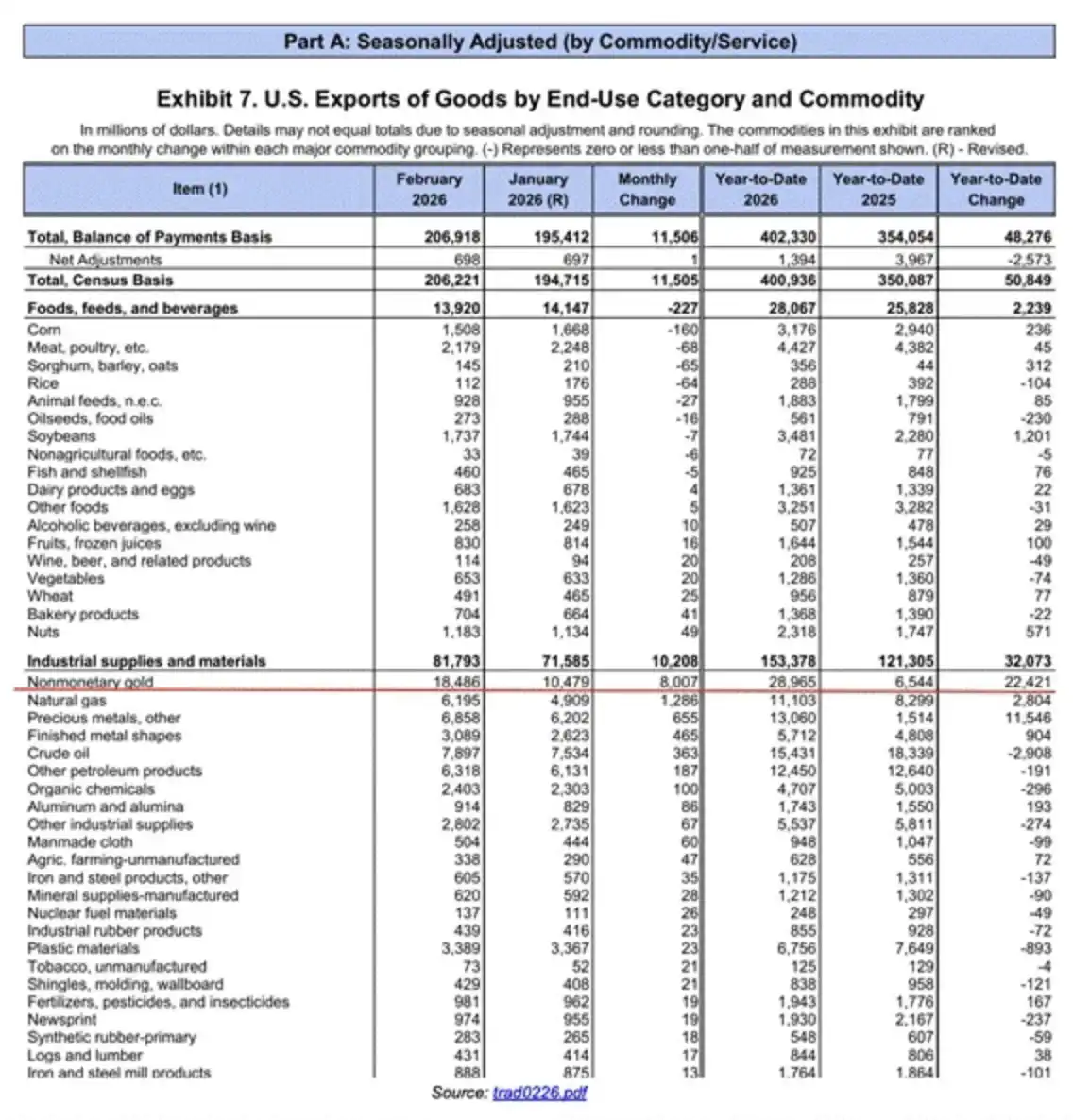
Non-monetary gold has become the largest export commodity from the United States for four out of the past five months, with a 342% year-over-year increase.
In other words, this money did not stay in the U.S. but was used to buy gold and then shipped out of the country. The narrative of "American manufacturing reshoring" appears rather ironic in the face of reality—the real "barbarous relic" leaving the U.S. is gold. For supporters hoping for a return of high-paying manufacturing jobs, this undoubtedly represents a failed expectation. Another presidential cycle has passed, and the working class has yet to truly benefit.
Step Two: Sell Gold for Yuan
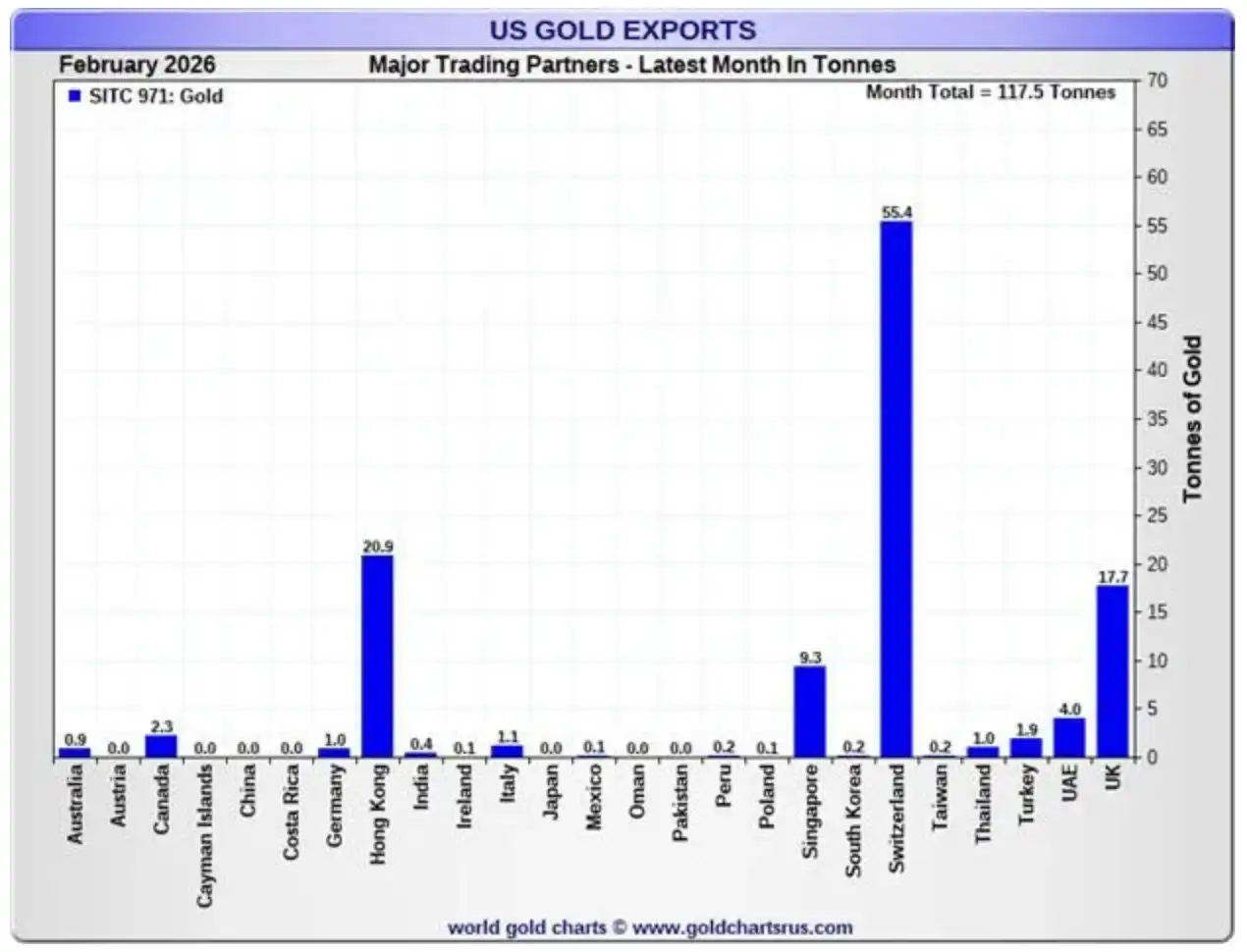
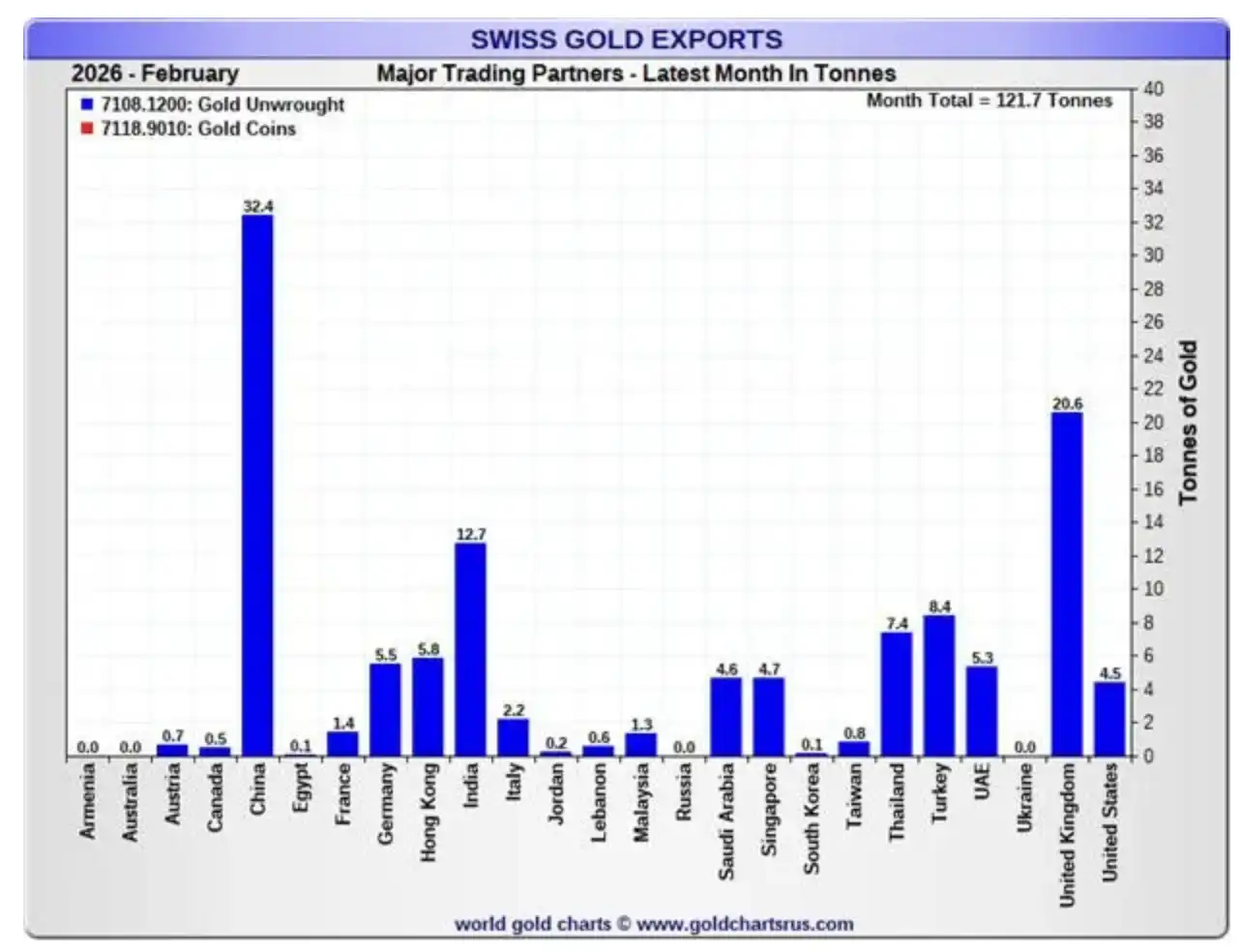
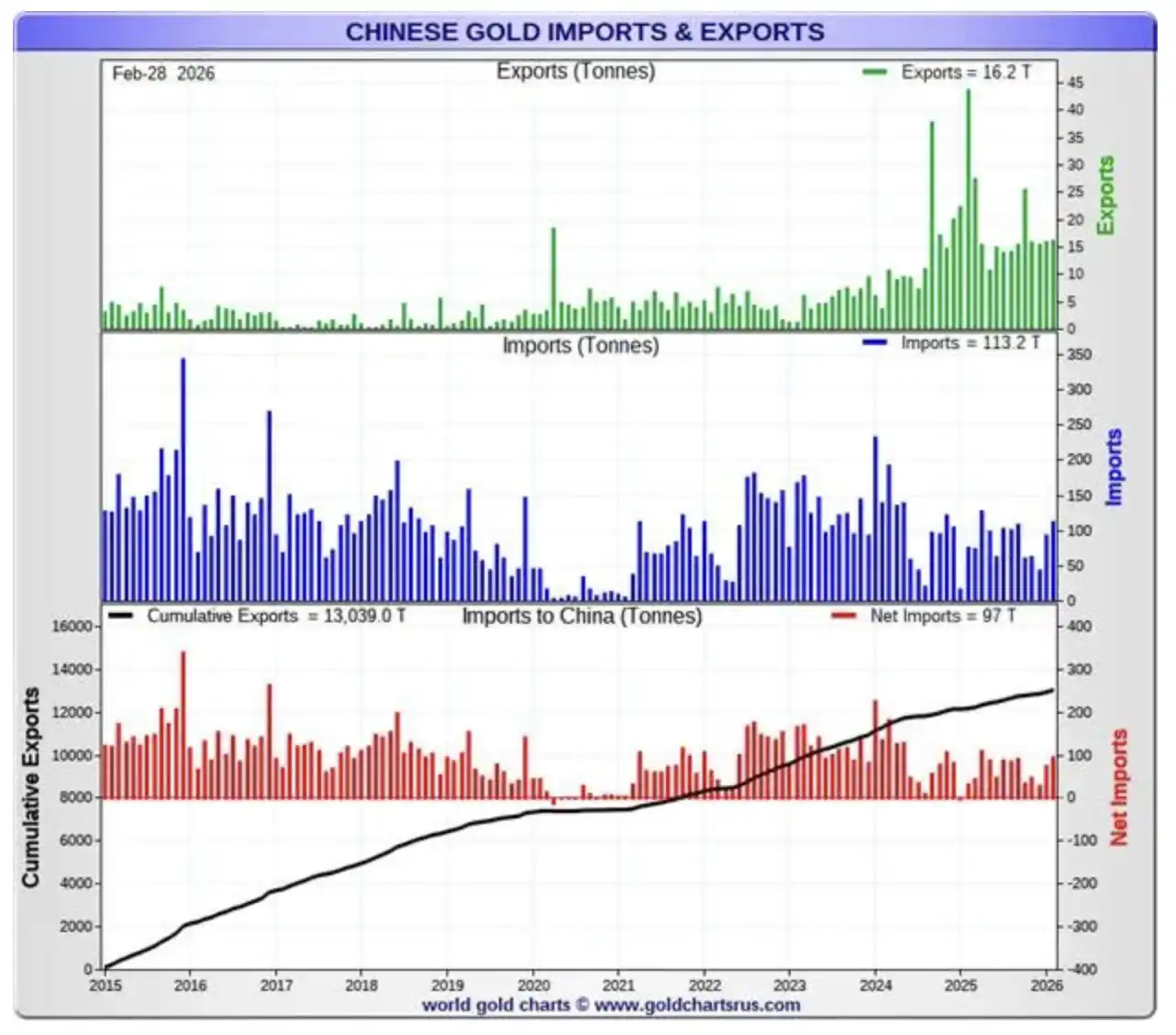
A Swiss refinery receives gold from the United States and remolds it into gold bars that meet the Chinese delivery standard.
The key to this step is that Switzerland is a core hub for global gold refining, able to reprocess gold bars of different specifications into high-purity standardized products that meet the demand of the Asian market, especially China (Discovery Alert). In other words, the gold flowing out of the United States does not directly enter China but undergoes a reshaping process through Switzerland, a "transit and standard conversion center."
Step Three: Pay the Tehran Toll
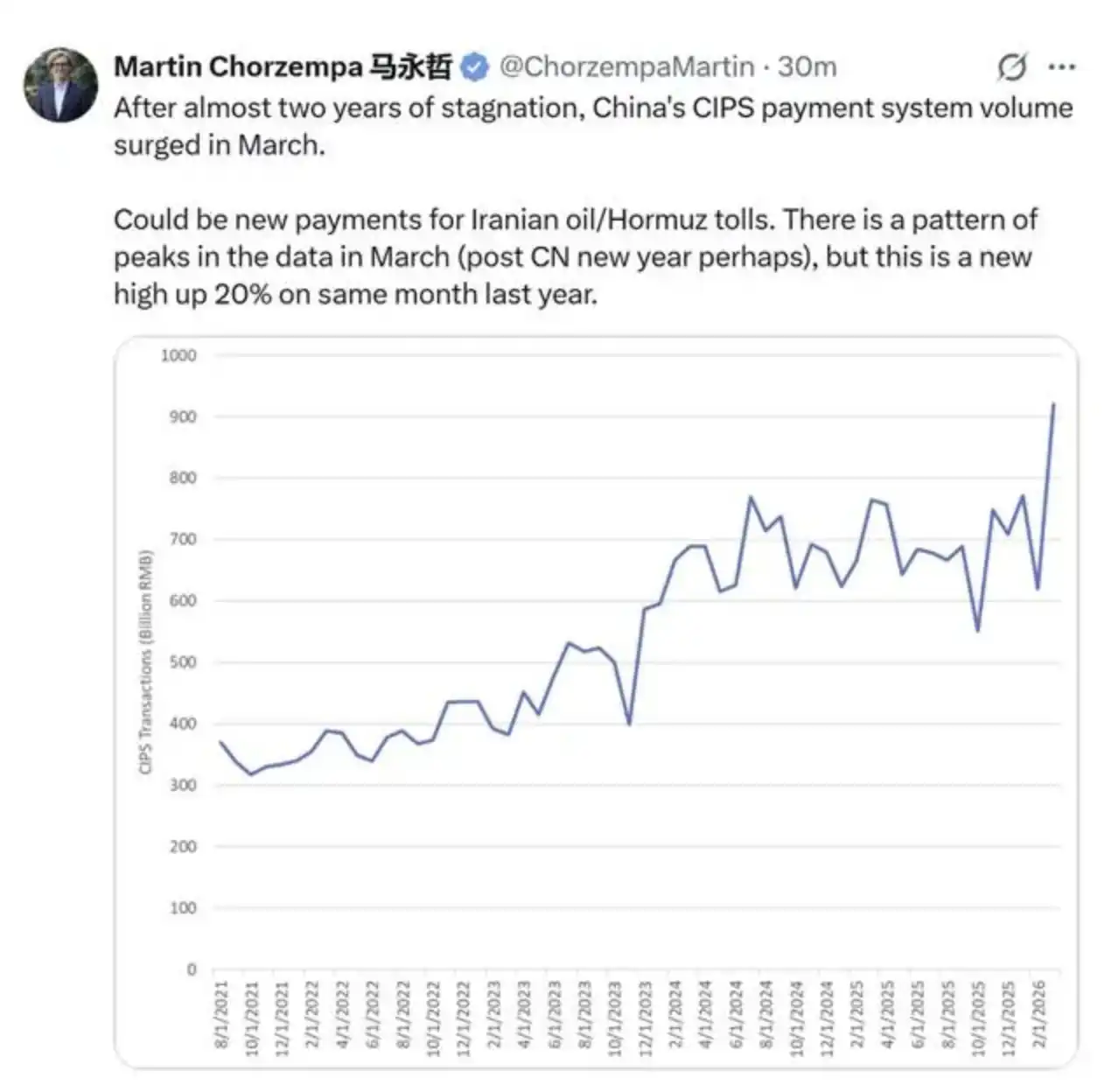
The usage of the Cross-Border Interbank Payment System (CIPS) is significantly increasing, with recent reports of "abnormal acceleration."
Buffalo Bill Benson was deadly serious when he said, "Either wear the dollar on you, or prepare for another round of sanctions."
Due to sanctions imposed by the United States nearly fifteen years ago, Iran has been unable to use the SWIFT payment message system. To deliver yuan to the Iranian Islamic Revolutionary Guard Corps (IRGC), reliance on China's fiat settlement system, the China International Payment System, is necessary. As evidenced, the volume of transactions through this system has significantly increased post the outbreak of war.
This series of charts illustrates a chain of fund flows: dollar assets are sold, then exchanged for gold, which is ultimately converted back into yuan to make payments to Tehran or other suppliers. The key is not that the dollar remains the dominant currency in trade currently, but that the market is forward-looking. Rather than dwelling on the fact that the current scale of yuan usage is still lower than that of the dollar, what is more crucial is the accelerating global adoption of the yuan in trade. For investors, avoiding dollar assets ahead of the market forming a consensus is a way to safeguard their portfolios.
Historically, the Pound Sterling nominally remained the global reserve currency before the 1944 Bretton Woods Agreement; however, in reality, as the U.S. economy emerged as the most productive global economy in the early 20th century, the dollar had already replaced the Pound Sterling as the de facto reserve currency.
By 2026, the United States is expected to have a trade deficit with the world's most productive economies (such as China, Japan, South Korea, Germany, Taiwan, etc.), and most countries will also have a trade deficit with China.
Let me reiterate this logic: If you have to pay fees to those "Stone Age" Middle Eastern powers in Chinese Yuan to receive your goods, what's the point of storing your assets in US dollars?
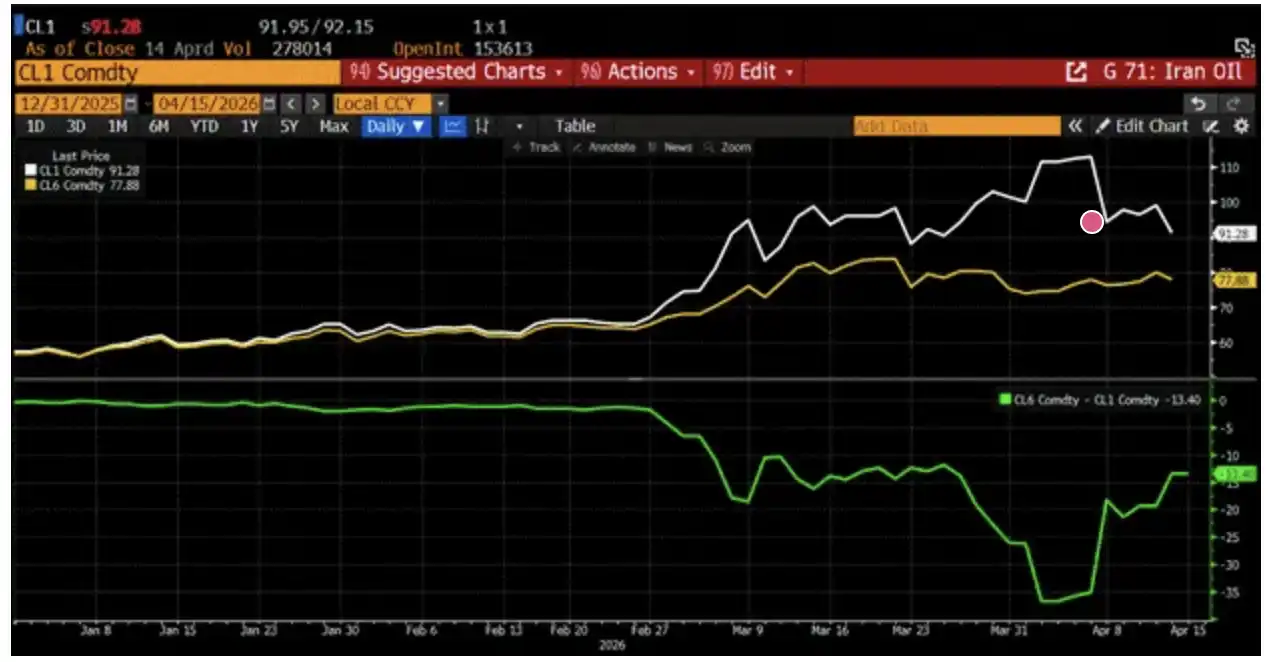
To determine whether the strait is "clear" or "blocked," refer to the chart above, or create a similar chart using any charting tool.
The upper chart shows the comparison of WTI crude oil futures prices in May 2026 (CL1, white line) and October 2026 (CL6, gold line). I chose WTI because this benchmark is more closely tied to the gasoline prices paid by American consumers. For Donald J. Trump, he only has an incentive to substantially cool tensions when oil prices put significant pressure on voters before the mid-term elections in November.
The lower chart displays the spread between these two contracts (deferred month minus near month); the curve is currently in "backwardation." As the far-month oil price has not risen as much as the near month, the market is essentially betting that the volume of oil flowing through the strait will eventually increase significantly.
If this assessment holds, then as the near-month price falls, the spread will widen. But if the opposite occurs—far-month prices rise and the spread narrows—it means the global economy will face a severe shock.
So, instead of focusing on the verbal battle between Trump and the Islamic Revolutionary Guard Corps (IRGC) of Iran, it's more important to keep an eye on this chart.
The Quantity versus Price of Money
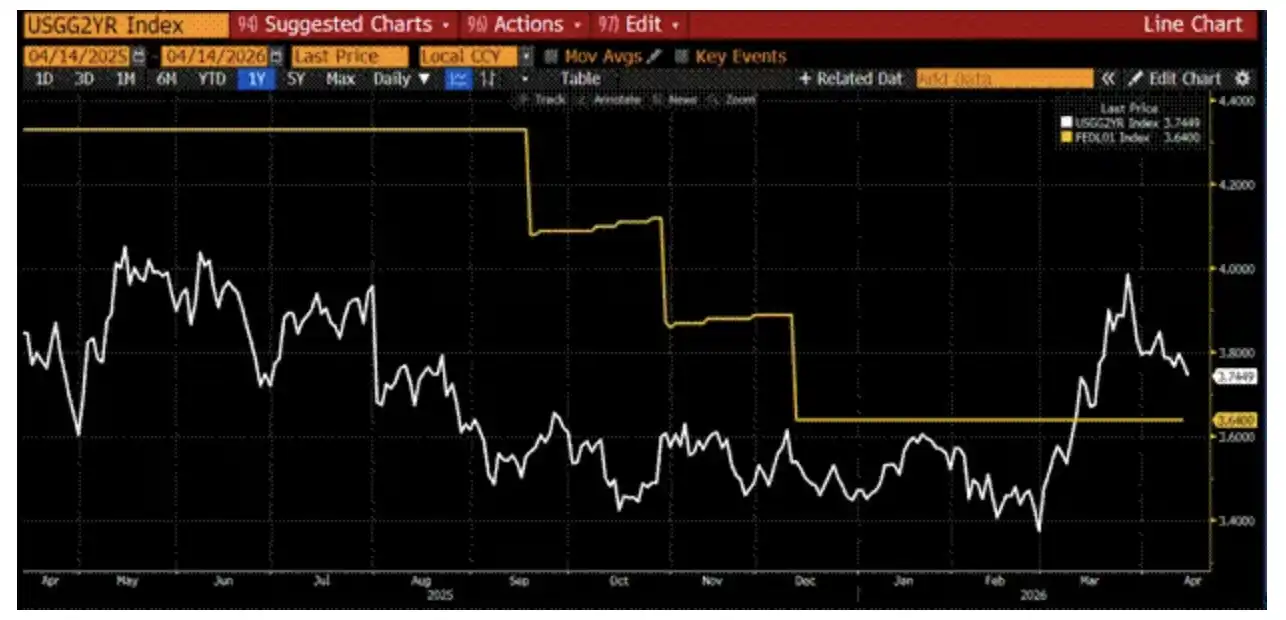
The two-year US Treasury bond yield (white line) surged shortly after the start of the war, far exceeding the Federal Funds Effective Rate (yellow line). This indicates that the market believed the Fed would raise interest rates to hedge against the rising energy inflation.
Now is the time to take sides: When pricing Bitcoin, do you believe the "quantity of money" or the "price of money" is more important? I believe it is the quantity of money that determines the price of Bitcoin, not the price of money. Since Bitcoin has no cash flow, the discount rate derived from central bank policy rates does not apply to this "internet magic money." However, because Bitcoin's supply is fixed, its value in terms of fiat currency depends on the total fiat currency supply.
The need to make a judgment on this point arises because we may be entering a new macro state: major central banks, including the Federal Reserve, may be hiking interest rates while simultaneously printing money (whether through direct money printing or through the indirect expansion of credit through the commercial banking system). As war drives up food and energy prices, capable governments often subsidize key input costs in the economy to prevent social unrest and even famine. However, to prevent inflation from spreading to all goods and services, central banks must raise interest rates to suppress demand, especially in credit-sensitive economic activities. Any entity relying on borrowing for consumption will reduce spending as the cost of credit rises.
If central banks stopped here, my judgment on Bitcoin would be straightforward: in an environment where people are cutting spending across the board except for food and energy, the price of Bitcoin would fall. However, the reality is that whether allies or adversaries of the "American order," all countries must increase defense spending and hoard key commodities. Do you want your country to be like Australia, with almost 100% of its refined energy dependent on imports from China? At the start of a war, China halted exports, and Australia had less than a month's worth of stockpiles. They had to seek help from Singapore and buy aviation fuel at extremely high prices, or else the entire country would come to a standstill.
To avoid becoming a "failed state," countries need to manufacture weapons (especially nuclear weapons) and hoard commodities, leading to a significant increase in government borrowing. If domestic private investors cannot or are unwilling to buy these "bad" government bonds, then the central bank or the commercial banking system will print money to take them up, thereby expanding the fiat money supply.
This combination of "rising interest rates (rising currency price) + expanding money supply (increasing currency quantity)" will cause differentiation in various risk assets: assets priced based on discounted cash flow will fall, while fixed or near-fixed supply assets (such as Bitcoin and gold) will rise as the banking system needs to expand credit to support government spending on war and resource hoarding.
Before continuing to read my analysis of Bitcoin's price trajectory in different scenarios, please bear in mind this: you must assess which is more important, the "quantity of money" or the "price of money," or else you will not understand the seemingly contradictory price performance among different risk assets.
Back to Normal
After the situation returns to a pre-war state, Bitcoin may experience a certain rebound. However, the deflationary shock caused by AI agents is still accumulating. Until the Federal Reserve provides enough liquidity to the banking system to fill the balance sheet gap caused by consumer credit defaults, Bitcoin is unlikely to see substantial gains. This does not mean it won't spike to $80,000 to $90,000 in the short term, but for me, the risk of injecting new fiat into the market is too high without a clear signal from the Federal Reserve to release liquidity. As I am already fully in a long position, seeing the net asset value rise is certainly satisfying, but the current risk-return ratio is not enough to push my position to the extreme.
I can't predict how much longer the banking system will truly hold up. But almost every week, I see similar news: some companies cutting a large number of white-collar employees due to AI efficiency gains, and consumer credit default rates continuing to rise.
Let me give you an example. Recently, I had a conversation with an entrepreneur running a crypto gaming company, a veteran in the industry. We talked about the impact of AI on business. With a background in computer engineering, he experimented with the latest Claude model during the 2025 Christmas season and was quickly amazed by its efficiency—it could generate deployable code in a very short time. A few months later, he gathered his team for an offline discussion, tasking them to build a round-the-clock AI programming workflow, including automating code reviews. The result was tested code available every morning. With AI assistance, an employee completed a six-month development plan in four days.
After this experience, he decided to immediately restructure the company's processes, leading to about 50% of the workforce being laid off in the following weeks.
In the age of AI agents, ordinary engineers will become redundant, while top engineers' productivity will increase by 10 to 100 times. As models continue to strengthen in various niche areas, a large number of mid-level knowledge workers will face unemployment risks.
The issue lies in the fact that even with unemployment insurance, the highest annual subsidy in U.S. states is about $28,000, while according to the Bureau of Labor Statistics (BLS) and the St. Louis Fed, the median salary for knowledge workers is around $85,000 to $90,000. The gap is substantial, leading to a situation where many people will start defaulting on their consumer credit to banks.
This is a fatal blow to the current "fictional" fiat fractional reserve banking system.
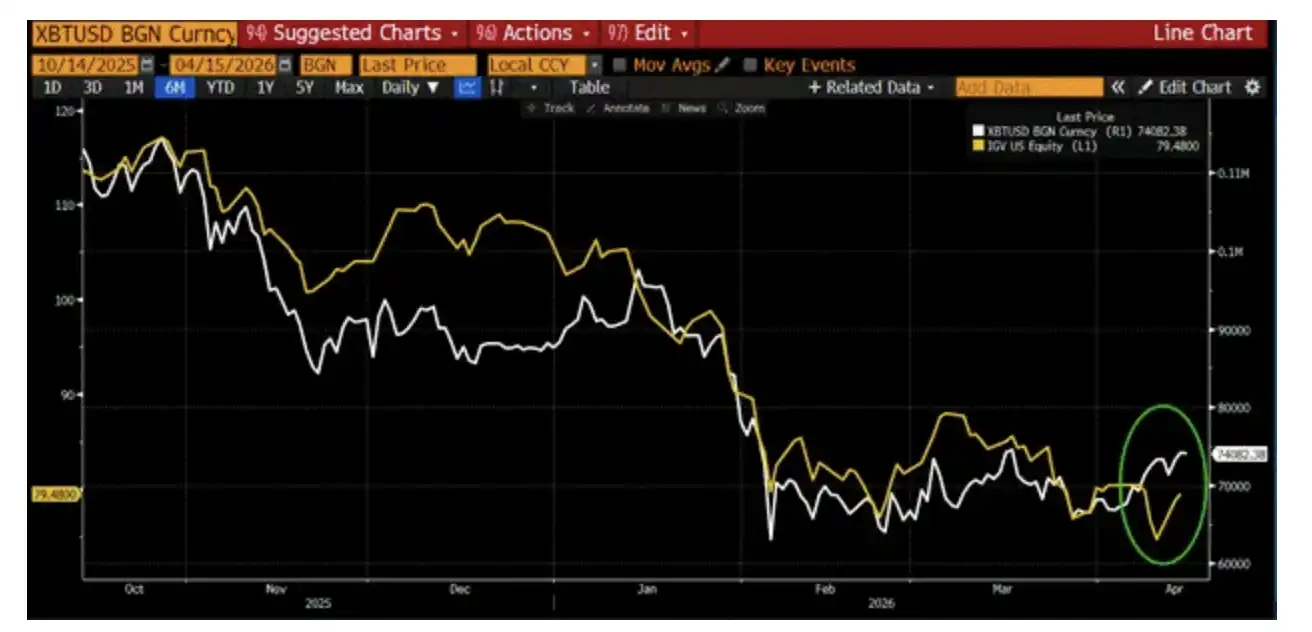
In conclusion, following the ceasefire, U.S. SaaS software stocks resumed their one-way downtrend, while Bitcoin stabilized and experienced a rebound. The temporary decoupling of this correlation is encouraging. However, in my view, it is still too early to assert that Bitcoin has already "seen through" the knowledge worker deflation caused by AI and is poised for a massive uptrend.
Tehran Toll Booth
As countries sell off dollar assets to acquire yuan and pay the "toll," U.S. bond and stock prices will come under pressure. This process may be gradual as there are still other payment methods besides the yuan. But considering the high leverage embedded in the entire system, even a slight shock could trigger a chain reaction—selling begets more selling, volatility spikes, and market liquidity freezes. At that point, central banks will have to intervene by "printing money" to stabilize the situation.
The key metric to watch is the MOVE Index (Market Openness to Volatility Index). Once this index rises above 130, it often signals an impending form of monetary easing.
As volatility rises, the prices of large U.S. tech stocks decline, making it difficult for Bitcoin to experience a strong rally. When investors start de-risking due to heightened market volatility and asset price declines, they usually sell off Bitcoin to meet margin requirements. Only when the situation deteriorates to a certain degree, with widespread expectations of a bailout, does Bitcoin truly surge.
Wait for Powell, or whichever Fed Chair at the time, to hit the "money printer" (Brrrr button) first. Trying to front-run this move before is not favorable in terms of risk-reward. I hope Bitcoin can hold above $60,000 during a systemic financial shock in traditional markets. If it can retest and hold this level for a second time, I would consider gradually increasing risk exposure.
The Star-Spangled Blockade & The Empire Strikes Back
If far-month crude oil futures prices rapidly rise to meet or surpass spot or near-month prices, the global economy will face disruption. At some point, demand contraction will hit U.S. bonds and stocks. Similar to the previous scenario, the initial reaction is still a Bitcoin sell-off. However, when the highly leveraged Western financial system begins to crumble, the money printer will fire up once again.
If the situation eventually evolves into: lifting the blockade through punitive strikes on Iran, while Iran in retaliation destroys the entire energy production capacity of the Persian Gulf, this could even lead to a collapse at the national level in Iran. In this case, a Bitcoin rally driven by "money printing" may be short-lived, as it would significantly increase the risk of a third world war.
Portfolio Construction
As an unleveraged, purely long investor, Maelstrom can rely on time and the natural power of compounding. Over the past few days, Bitcoin's slight outperformance relative to the IGV (U.S. Software SaaS ETF) is a positive signal, prompting me to reassess the bearish thesis formed earlier based on "AI-induced knowledge work deflation."
At this stage, the only assets I am willing to add to the risk exposure are gold and $HYPE (Hyperliquid's governance token). HIP-4 is set to launch in a few weeks, and I expect it to capture a significant market share in the prediction market race from Polymarket and Kalshi.
Moreover, the only thing I can do every day is pray that Satoshi Nakamoto can "influence" the minds of global political elites to choose dropping acid instead of dropping bombs.
You may also like

a16z New Post: Predicting the Market, Entering the Fast Forward Phase

a16z New Article: Predictive Markets Entering Fast-Forward Phase

a16z founder: In the age of Agents, what truly matters has changed

The President of Kyrgyzstan meets with Sun Yuchen, and TRON collaborates with Kyrgyzstan to build a new pattern of digital economy in Central Asia
46 minutes, $292 million stolen, DeFi faces development dilemma again

How to Earn Free USDT in 2026: No High Volume Required (WEEX Poker Party Guide)
Is Joker Crypto legit in 2026 or just another memecoin? Can You Really Earn Passive Income with Joker Crypto in 2026? Learn how Joker staking rewards work, how to earn NFT bonuses, expected APY ranges, gas-fee rebates, and how to avoid crypto scams before joining.

How to Get Free USDT Welcome Bonus in 2026: Earn Up to 700 USDT on WEEX
Legit Free Welcome Bonus 2026: Learn how to earn up to 700 USDT on WEEX with Auto Earn Boost Fest. Increase your balance, activate Auto Earn, and qualify automatically.

AI Agent Payments Just Got Real: Utexo × x402 Brings 50ms USDT Transactions to Internet Scale
Utexo integrates USDT into the x402 protocol, enabling 50ms instant payments embedded natively in HTTP requests. Explore how this breakthrough is rewriting the rules for AI agent payments, API monetization, and the machine-to-machine economy.

DWF Deep Report: AI in DeFi Outperforms Humans in Yield Optimization, but Complex Trades Still Lag Behind by 5 Times

What Separates Smart Money from the Crowd in Crypto? Insights from Freedom of Money
Most crypto traders lose money not because of bad luck, but because they misunderstand how the market really works. From Freedom of Money to the rise and fall of Sam Bankman-Fried, they highlight a key divide in crypto: those who build the market and those who chase it. This reading guide explores essential books that reveal how narrative, regulation, capital, and psychology shape long-term success in the crypto industry.

The Risk Management Core Team has just been ousted, and Aave is now facing a $200 million default.

The $293 million bug wasn't in the code; so, what's the deal with the "DVN Configuration Bug," which led to the largest hack of 2026?

a16z on Recruitment: How to Choose Between Crypto-Native and Traditional Talent?
The biggest DeFi heist of 2026, hackers easily took advantage of Aave

Will Robots Replace Humans? He Says No!
Binance Coin's Price Skyrockets 15x to All-Time High, Saved by Three Bull Market Lifelines

The organization has accessed the prediction market, but is stuck at the third stage

Head of crypto VC collective shrinks: a16z crypto fund management scale plummets by 40%, Multicoin cut in half
a16z New Post: Predicting the Market, Entering the Fast Forward Phase
a16z New Article: Predictive Markets Entering Fast-Forward Phase
a16z founder: In the age of Agents, what truly matters has changed
The President of Kyrgyzstan meets with Sun Yuchen, and TRON collaborates with Kyrgyzstan to build a new pattern of digital economy in Central Asia
46 minutes, $292 million stolen, DeFi faces development dilemma again
How to Earn Free USDT in 2026: No High Volume Required (WEEX Poker Party Guide)
Is Joker Crypto legit in 2026 or just another memecoin? Can You Really Earn Passive Income with Joker Crypto in 2026? Learn how Joker staking rewards work, how to earn NFT bonuses, expected APY ranges, gas-fee rebates, and how to avoid crypto scams before joining.



 App
App